
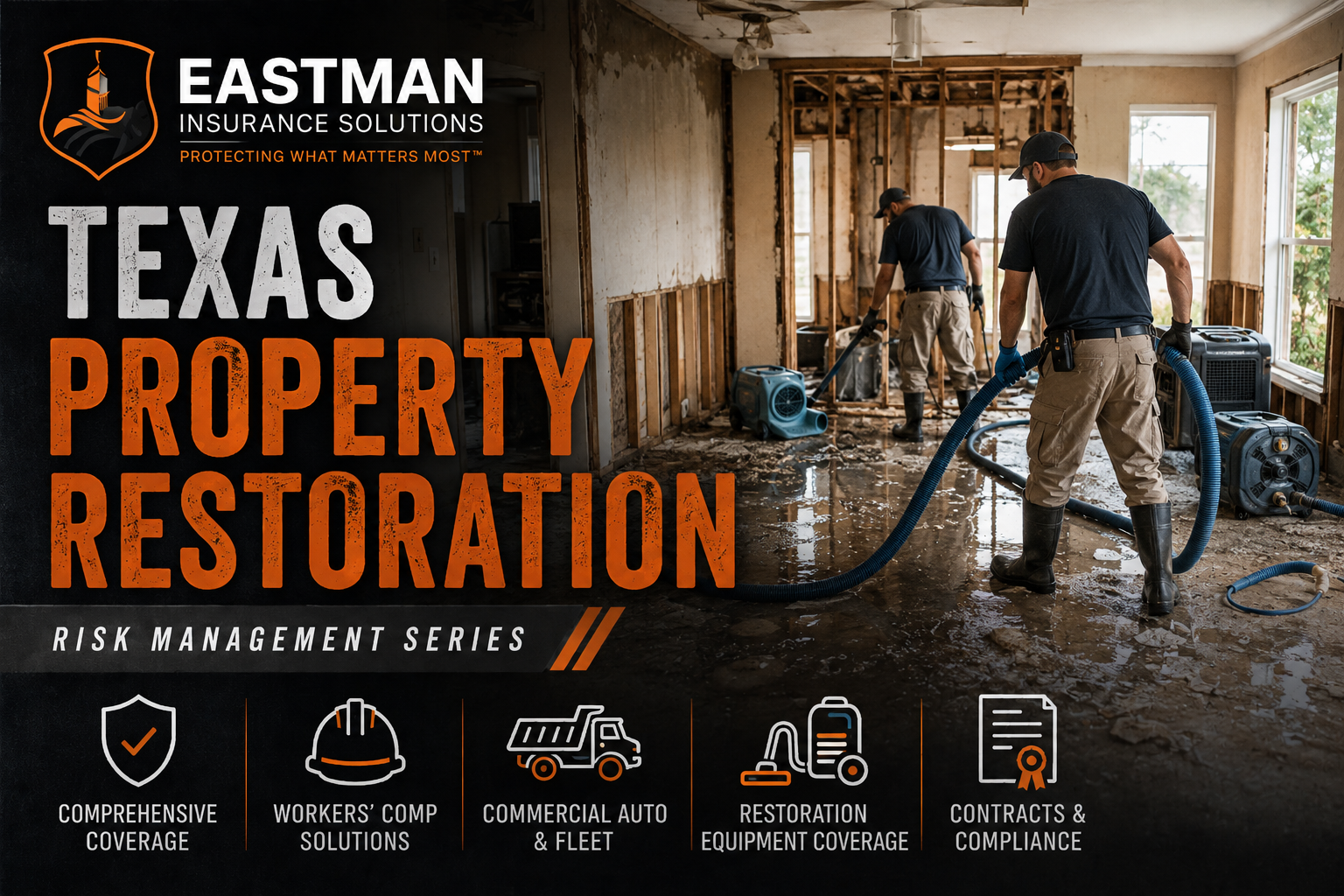
Property restoration contractors operate in an unusual environment.
Their customers rarely call when everything is going well.
A restoration company is typically entering a property after something has already gone wrong—a water loss, fire, storm, sewage backup, mold concern, or another event that has damaged a home or commercial building.
That creates a fundamentally different risk profile from many other service businesses.
Employees may be working inside partially damaged structures. Crews move equipment from property to property. Contents may need to be handled or relocated. Water extraction and drying decisions can later be questioned. Demolition can uncover additional damage. Mold or other contaminants may be present. And the contractor may be working alongside property owners, insurance adjusters, subcontractors, consultants, and other trades—all while trying to document what happened and complete the work quickly.
As a restoration company grows, those exposures become more difficult to manage through owner oversight alone.
At Eastman Insurance Solutions, we believe the insurance program for an established restoration contractor should reflect the way the company actually operates—not simply the fact that it is categorized as a contractor.
Growth Changes the Restoration Company’s Risk
A smaller restoration company may have an owner who remains personally involved in most significant losses.
The owner may inspect the property, develop the scope, communicate with the customer, oversee employees, review documentation, and know exactly what equipment has been deployed.
Growth changes that.
Multiple crews may be responding to different losses simultaneously. Project managers begin making decisions independently. Vehicles and equipment move continuously between jobs. New employees are brought into the field. Subcontractors may be used to expand capacity. Emergency calls arrive after normal business hours.
Eventually, the owner cannot personally supervise every decision being made in the field.
That means the company increasingly depends on training, documentation, supervision, and repeatable operating procedures.
This is an important transition because restoration claims are often influenced not only by what happened, but by what can later be demonstrated about how the company responded.
Working Inside an Existing Loss Creates a Unique Liability Problem
Most contractors begin work on property that is generally intact.
Restoration contractors often arrive after substantial damage has already occurred.
That distinction matters.
Imagine a contractor responding to a major water loss.
The building already has water damage before the restoration company arrives. The contractor extracts water, removes damaged materials, deploys drying equipment, and monitors the property.
Several weeks later, additional damage or mold is discovered.
Now a difficult question may arise:
What damage existed before the restoration contractor arrived, and what damage is allegedly connected to the work performed afterward?
That can become a complicated liability dispute.
General Liability Insurance is an important foundation of a restoration contractor’s insurance program, but insurance alone cannot resolve poor documentation.
Photos, moisture readings, drying logs, customer communications, signed authorizations, scope documentation, and records of conditions encountered can become extremely important when a claim is later disputed.
For restoration contractors, documentation is a risk-management tool.
Water Mitigation Creates Long-Tail Exposure
A water-loss job may appear complete when the equipment is removed and the customer returns to normal use of the property.
But the contractor’s exposure may continue.
Questions can arise later about whether moisture was properly identified, whether affected materials should have been removed, whether drying was sufficient, or whether conditions contributed to subsequent microbial growth or property damage.
That creates what is often called a completed operations exposure.
The work may be finished.
The claim may not occur until later.
This is particularly important as restoration companies increase job volume. A contractor completing hundreds of mitigation projects annually has accumulated a much larger body of completed work than it had during its earlier years.
That makes consistent procedures increasingly important.
The quality of moisture documentation, equipment logs, photographs, customer sign-offs, and project records may become as important after the job as they were while the work was being performed.
Mold, Sewage and Contaminated Environments Change the Exposure
Not every water loss involves clean water.
Restoration contractors may encounter sewage, mold, bacteria, chemicals, smoke residue, contaminated materials, and other potentially hazardous conditions.
These exposures can create problems that aren’t necessarily addressed the same way as ordinary property damage.
Pollution exclusions are common within traditional liability insurance policies. Depending on the contractor’s services and policy structure, separate Contractors Pollution Liability Insurance may become an important part of the insurance program.
This is particularly relevant for companies performing mold remediation or regularly working in environments involving contaminants.
The issue isn’t simply:
“Do we perform mold work?”
A better question is:
“What contaminants can our employees encounter or disturb during the work we actually perform?”
A company responding to water losses may discover microbial growth during demolition. Fire restoration can involve smoke, soot, and damaged materials. Sewage losses introduce another category of contamination entirely.
The insurance program needs to reflect the reality of those operations.
Employees Work in Buildings That May Already Be Unsafe
Restoration employees routinely enter environments that other people are trying to leave.
A fire-damaged building may have structural concerns, damaged electrical systems, debris, unstable walking surfaces, and poor air quality.
A water loss can create wet floors, electrical hazards, contaminated materials, lifting exposures, and demolition work.
Employees may move heavy drying equipment, remove flooring or drywall, handle contents, work in confined spaces, or perform physically demanding work for extended periods.
That makes Workers’ Compensation Insurance a significant component of the restoration company’s risk strategy.
But again, the premium is only part of the conversation.
An established contractor should understand what is driving its employee injuries.
If strains repeatedly occur while moving equipment, that is useful information.
If newer employees experience more injuries during demolition, training may deserve attention.
If crews are experiencing cuts or puncture wounds, protective equipment and work practices may need review.
If claims are staying open for extended periods, return-to-work and claims-management practices may need attention.
The loss history can tell management where the operation is breaking down.
A Restoration Company Is Also a Fleet-Based Business
Restoration contractors may operate vans, pickups, box trucks, supervisor vehicles, and other vehicles that spend much of the day moving between customer locations.
Emergency response adds another dimension.
When a customer has water pouring through a ceiling at 2:00 in the morning, there is pressure to respond quickly.
That doesn’t make the driving exposure disappear.
Commercial Auto Insurance should be supported by a broader fleet-management strategy involving driver screening, Motor Vehicle Record reviews, distracted-driving expectations, accident reporting, vehicle-use policies, and driver accountability.
The consequences of a serious accident can extend well beyond damage to the company vehicle.
An employee may be injured, creating a Workers’ Compensation claim. Another driver may be injured. Equipment inside the vehicle may be damaged. The vehicle may be unavailable while repairs are made.
One accident can touch several parts of the insurance program at once.
As the company adds vehicles and employees, fleet management needs to become a system rather than an assumption that employees will drive safely.
Restoration Equipment Moves Constantly
Air movers, dehumidifiers, extractors, generators, moisture meters, air scrubbers, thermal imaging equipment, containment systems, and other specialty equipment can represent a substantial investment.
Much of that property isn’t sitting safely inside the company’s warehouse.
It may be deployed across dozens of customer locations.
That creates an important distinction between property that remains at the company’s premises and equipment that travels with the operation.
Inland Marine Insurance can help address certain mobile tools and equipment, depending on the policy.
But restoration companies face another challenge: knowing where everything is.
A growing company may have equipment deployed across multiple jobs for days or weeks at a time. Without good tracking procedures, equipment can be misplaced, left behind, stolen, or simply become difficult to account for.
Accurate equipment inventories, identification numbers, deployment records, GPS or electronic tracking where appropriate, and clear responsibility for equipment can therefore become part of the company’s broader risk-management strategy.
You can’t effectively insure an equipment inventory you don’t accurately understand.
Handling Customer Contents Creates Another Layer of Responsibility
Some restoration companies do more than mitigate damage to the building.
They may handle, pack, move, store, clean, or otherwise take responsibility for customer contents.
That can create a very different exposure.
Furniture, electronics, artwork, collectibles, business equipment, documents, and personal property may be removed from a damaged structure and placed under the contractor’s control.
If something is lost, damaged, stolen, or disputed, the contractor may face a claim.
This makes inventory procedures and documentation particularly important.
Photographs, condition reports, itemized inventories, chain-of-custody procedures, storage practices, and customer acknowledgments can help establish what property was handled and its condition.
The more contents a company handles, the less practical it becomes to rely on informal procedures.
Again, growth creates the need for systems.
Subcontractors Can Expand Capacity—and Liability
Restoration work frequently requires other trades.
A restoration contractor may use subcontractors for roofing, plumbing, electrical, reconstruction, specialty cleaning, demolition, environmental work, or other services.
Subcontracting can allow the company to respond to larger losses and expand capacity without performing every trade internally.
But it also introduces another source of risk.
When something goes wrong, the customer may not care which subcontractor actually caused the damage. The restoration contractor or general contractor may still become involved in the claim.
That makes contractual risk transfer important.
Written subcontractor agreements, appropriate insurance requirements, Certificates of Insurance, additional insured provisions where appropriate, Workers’ Compensation requirements, and consistent documentation should be part of a broader subcontractor-management process.
A Certificate of Insurance by itself isn’t a risk-transfer program.
The contract, insurance requirements, actual policy coverage, and ongoing compliance all need to work together.
Larger Projects Can Create Larger Liability Losses
As a restoration contractor becomes more successful, the size and complexity of the losses it handles may increase.
A small residential water loss creates one level of exposure.
A major commercial water loss affecting multiple floors, tenants, equipment, or business operations creates something entirely different.
The same is true when restoration work expands into larger reconstruction projects.
The company’s liability limits should evolve with the size of the risks it is assuming.
Commercial Umbrella and Excess Liability Insurance can provide additional limits above certain underlying liability policies, subject to the policy structure.
Customers and contracts may establish minimum limits.
But those requirements shouldn’t be the only consideration.
An established restoration contractor should also ask:
What is the realistic severity of the claims our operation could generate?
That is a much better starting point for evaluating liability limits than simply buying whatever amount the latest contract requires.
Claims Management Matters in a Claims-Driven Industry
Restoration contractors understand claims from the customer’s perspective better than most businesses.
Ironically, that doesn’t always mean they manage their own insurance claims strategically.
A company’s loss runs can provide valuable information about its operation.
Patterns involving vehicle accidents, employee injuries, water-damage allegations, equipment theft, subcontractor disputes, or other losses can reveal where management attention may be needed.
Significant open claims also deserve ongoing review.
A liability claim involving disputed property damage can remain open for an extended period. A Workers’ Compensation claim can develop substantial reserves. An automobile accident can evolve into litigation.
These claims shouldn’t disappear into the carrier’s system until the next renewal.
For an established restoration contractor, claims management should be part of the company’s ongoing risk strategy.
The objective isn’t to interfere with legitimate claim handling.
It’s to understand what is happening, why it is happening, and what the company can learn from it.
The Insurance Program Should Reflect the Restoration Company You’ve Become
There isn’t one standard insurance package appropriate for every restoration contractor.
A company performing emergency water mitigation has a different risk profile from one performing mold remediation, contents restoration, fire restoration, large-loss commercial work, or full reconstruction.
Many established restoration contractors may need to evaluate a combination of General Liability, Workers’ Compensation, Commercial Auto, Commercial Property, Inland Marine, Contractors Pollution Liability, Umbrella or Excess Liability, Cyber Liability, and other specialized coverage based on their actual operations.
But adding policies isn’t the objective.
The objective is making sure the insurance structure reflects the company behind them.
When a restoration company adds crews, vehicles, locations, equipment, new services, larger commercial projects, or more subcontracted work, the insurance and risk-management strategy should be reviewed along with the operation.
The program that insured the company you were five years ago may not adequately reflect the company you’ve built today.
Beyond the Coverage™ for Texas Property Restoration Companies
At Eastman Insurance Solutions, we believe established restoration contractors need an insurance relationship that goes beyond placing policies and delivering renewal proposals.
Our approach starts with understanding the operation.
Identify Risk → Reduce Risk → Transfer Remaining Risk
For a restoration company, that may mean evaluating employee injuries, fleet performance, pollution exposures, documentation practices, subcontractor controls, equipment protection, claims history, contractual risk transfer, and the insurance policies designed to protect the organization when something goes wrong.
Insurance transfers part of the risk.
Strong operating procedures help manage the rest.
For additional resources developed specifically around this industry, visit the Texas Property Restoration Insurance & Risk Management Hub.
Frequently Asked Questions About Property Restoration Insurance in Texas
What insurance should an established property restoration company carry?
The appropriate insurance program depends on the services the company actually performs.
An established restoration contractor may need to evaluate General Liability, Workers’ Compensation, Commercial Auto, Inland Marine, Commercial Property, Contractors Pollution Liability, Umbrella or Excess Liability, Cyber Liability, and other specialized coverage.
A contractor performing mold remediation or handling customer contents may have exposures that aren’t present in a company performing more limited restoration services.
Why is Pollution Liability important for restoration contractors?
Restoration companies may encounter mold, sewage, bacteria, smoke residue, contaminated materials, and other environmental conditions during their work.
Traditional General Liability policies may contain pollution exclusions or limitations. Contractors Pollution Liability may therefore be important depending on the company’s operations and policy structure.
Why is documentation so important for restoration contractors?
Restoration companies frequently begin working after property damage has already occurred.
Photos, moisture readings, drying logs, project records, customer communications, and other documentation can help establish the property’s condition, the work performed, and how the contractor responded if a claim is later disputed.
How should a restoration company insure drying and mitigation equipment?
Mobile restoration equipment may require Inland Marine Insurance rather than relying solely on traditional Commercial Property coverage.
When should a restoration contractor review its insurance program?
Material changes in the business should prompt a review.
Adding crews, vehicles, locations, equipment, mold remediation, contents handling, reconstruction, larger commercial projects, or subcontractors can materially change the company’s risk profile before the next insurance renewal.
Protect the Restoration Company You’ve Built
A restoration company’s reputation is built on its ability to respond when somebody else’s property is already in trouble.
That creates a significant responsibility.
As the company grows, there are more employees making decisions, more vehicles on the road, more equipment deployed, more projects underway, and potentially much larger losses being handled.
The risk-management strategy needs to grow with that responsibility.
Eastman Insurance Solutions helps established Texas restoration contractors connect commercial insurance, claims management, pollution liability, fleet safety, equipment protection, and operational risk management to the way their businesses actually operate.
If your company has grown but your insurance and risk-management strategy hasn’t evolved with it, it may be time for a closer look.
Schedule a Risk Consultation →
Looking for more insurance tips?
- NEMT Insurance in Texas: What Growing Transportation Providers Need to Know
- Insurance for Texas Property Owners Who Lease Homes to IDD Care Providers
- Appliance Repair Business Insurance in Texas: Managing Risk as Your Company Grows
- Garage Door Company Insurance in Texas: What Service & Installation Businesses Need to Know
- Property Restoration Insurance in Texas: Protecting a Growing Restoration Company