Risk Management Guidance for Texas Property Restoration Companies
Property restoration companies operate where urgency, damaged property, environmental conditions, customer expectations, and liability collide.
A restoration crew may respond to a water loss in the middle of the night, enter a partially damaged structure, remove wet materials, deploy drying equipment, handle customer contents, coordinate subcontractors, document damage for an insurance claim, and remain responsible for equipment and work at the property for days or weeks.
Every phase creates risk.
Eastman Insurance Solutions helps established and growing Texas restoration companies build insurance and risk-management programs(opens in new tab) around how their operations actually work.
Through our Beyond the Coverage™ approach, we help restoration companies evaluate environmental liability, employee safety, commercial auto, mobile equipment, customer-property exposure, subcontractor risk, completed operations, claims, and the operational risks that become more complex as the company grows.
The Texas Property Restoration Operating Environment
Restoration companies rarely have the luxury of working in controlled environments.
Your crews may respond to:
- Water damage
- Fire and smoke losses
- Mold
- Sewage backups
- Storm damage
- Flood-related losses
- Structural damage
- Contaminated materials
- Emergency board-up situations
- Large commercial losses
Unlike a traditional contractor entering a planned project, restoration teams may arrive when the condition of the property is still evolving.
Water may still be flowing.
Electrical systems may be compromised.
Structural components may be damaged.
Contents may need to be moved.
Mold or other contaminants may be present.
Property owners may be under significant stress, while insurance carriers, adjusters, contractors, property managers, and other parties are simultaneously involved.
That makes restoration a combination of emergency response, field service, environmental exposure, property handling, construction activity, and claims documentation.
The insurance program needs to recognize all of it.
Core Risk Areas for Texas Property Restoration Companies
Water, Mold, Sewage & Environmental Liability
Environmental exposure is one of the most important distinctions between restoration and ordinary property-service businesses.
Restoration companies may intentionally work around water damage, mold, sewage, smoke residue, contaminated materials, and other conditions that standard liability policies may treat differently.
Claims can involve:
- Mold allegations
- Improper remediation
- Cross-contamination
- Sewage exposure
- Failure to contain affected areas
- Inadequate drying
- Air-quality allegations
- Contaminant dispersal
- Disposal of affected materials
- Bodily injury allegations
A standard General Liability(opens in new tab) policy should not simply be assumed to address every environmental loss.
Restoration companies should evaluate whether their operations require specialized Contractors Pollution Liability or Environmental Liability protection and how pollution exclusions apply to the work they perform.
The details matter.
A company whose core business involves responding to contaminated environments needs an insurance program that understands that exposure.
Customer Property, Contents & General Liability
Restoration crews work inside buildings that are already damaged.
That makes determining what damage existed before the restoration company arrived and what happened afterward particularly important.
Crews may move furniture, electronics, inventory, artwork, appliances, personal belongings, and other customer property while performing mitigation work.
Claims can involve:
- Additional water damage
- Damaged contents
- Lost property
- Scratched flooring
- Damage during pack-out
- Allegations of theft
- Damage caused by drying equipment
- Property damage during demolition
- Damage to unaffected portions of the building
General Liability Insurance(opens in new tab) may provide protection for certain covered third-party property-damage claims, but care, custody, or control exclusions and other policy provisions can become particularly important.
Documentation should begin before work does whenever conditions allow.
Photographs, videos, moisture readings, inventories, customer authorizations, and written records can help establish what the restoration company encountered when it arrived.
Emergency Response, Employee Safety & Workers' Compensation
Restoration employees regularly enter environments where hazards may not yet be fully understood.
Crews can encounter:
- Wet floors
- Damaged structures
- Electrical hazards
- Contaminated water
- Mold
- Smoke residue
- Sharp debris
- Heavy materials
- Confined spaces
- Heat
- Ladders
- Demolition work
Emergency response can also create pressure to begin work quickly.
That makes employee hazard assessment and training especially important.
Workers' Compensation(opens in new tab) should be supported by procedures for:
- Personal protective equipment
- Site hazard assessment
- Respiratory protection where applicable
- Lifting
- Ladder use
- Electrical hazards
- Contaminated environments
- Heat exposure
- Incident reporting
- Return-to-work
As the company grows, workers' compensation losses should be analyzed by type of restoration work, not simply by total claim count.
A pattern of injuries during demolition or water mitigation may reveal a very different operational issue from a pattern of vehicle accidents.
Commercial Auto, Drivers & Catastrophe Response
Restoration companies are mobile by necessity.
Vehicles may transport technicians, generators, extraction equipment, air movers, dehumidifiers, tools, containment materials, and other equipment to losses across a large geographic area.
Storm response can increase that exposure significantly.
Crews may work long hours, travel greater distances, operate in unfamiliar areas, and drive during poor weather conditions.
Commercial Auto Insurance(opens in new tab) should therefore be supported by:
- Driver qualification
- MVR reviews
- Vehicle-use policies
- Distracted-driving controls
- Vehicle maintenance
- Driver fatigue procedures
- Accident reporting
- Trailer safety where applicable
- Catastrophe deployment procedures
The risk can change dramatically during a major Texas storm event.
A fleet-management program that works during normal operations may need additional controls when crews are deployed for catastrophe response.
Drying Equipment, Tools & Property in Transit
Restoration companies can accumulate significant amounts of mobile equipment.
That may include:
- Air movers
- Dehumidifiers
- Moisture meters
- Extractors
- Generators
- HEPA equipment
- Negative-air machines
- Thermal imaging equipment
- Demolition tools
- Trailers
- Specialty remediation equipment
Much of this property spends its life away from the company's primary location.
Some equipment may remain unattended at customer properties for days.
That creates exposure to:
- Theft
- Vandalism
- Fire
- Vehicle accidents
- Storm damage
- Equipment breakdown
- Customer interference
- Property left at jobsites
An Inland Marine or equipment coverage strategy should reflect how equipment actually moves through the operation.
Companies should also maintain an accurate equipment inventory and understand which equipment is currently deployed to which jobs.
Subcontractors, Reconstruction & Contractual Risk
Many restoration companies perform more than emergency mitigation.
They may also coordinate or perform:
- Demolition
- Drywall
- Flooring
- Painting
- Carpentry
- Roofing
- Electrical work
- Plumbing
- Reconstruction
Some of that work may be subcontracted.
That changes the risk profile.
A restoration company can still be drawn into a claim arising from work performed by a subcontractor, particularly when the restoration company contracted directly with the property owner.
Subcontractor controls should consider:
- Written agreements
- Certificates of insurance
- Additional insured requirements
- Appropriate liability limits
- Workers' Compensation
- Scope of work
- Licensing where required
- Indemnification
- Documentation
EIS's Contract & Certificate Compliance(opens in new tab) resources can help businesses build a more consistent approach to contractual risk transfer.
The goal is not simply collecting a certificate.
It is understanding who is assuming which risk.
Documentation, Scope Disputes & Claims Readiness
Documentation is unusually important in restoration.
The company is often working on property that is already the subject of an insurance claim.
That means multiple parties may later evaluate:
- What damage existed
- What work was necessary
- What work was authorized
- What materials were removed
- How long equipment was deployed
- What moisture levels were recorded
- What changed during the project
- Whether additional damage occurred
Restoration companies should maintain consistent documentation around:
- Initial property condition
- Photographs and video
- Moisture readings
- Customer authorization
- Scope changes
- Equipment placement
- Daily monitoring
- Contents
- Subcontractors
- Communications
- Completion
Good documentation supports billing and customer communication.
It can also become part of the company's defense when someone later alleges that the restoration work caused or worsened a loss.
Risk Management Changes as Restoration Companies Grow
A restoration company handling local residential water losses has a different risk profile from an organization responding to commercial losses and catastrophe events across Texas.
Growth may bring:
- More technicians
- More vehicles
- More equipment
- Larger losses
- Commercial projects
- More subcontractors
- Multiple branches
- Catastrophe deployments
- Higher payroll
- Larger equipment inventories
- More complex contracts
- Greater claim severity
Leadership should begin asking:
- Are site-safety procedures consistent across crews?
- Is equipment being tracked?
- Are drivers reviewed regularly?
- Are subcontractor insurance requirements enforced?
- Are environmental exposures properly insured?
- Are commercial jobs changing the company's liability profile?
- Are catastrophe crews working excessive hours?
- Are customer-property claims increasing?
- Are workers' compensation claims showing patterns?
- Are liability and umbrella limits keeping pace with project size?
- Have reconstruction services expanded?
- Does the insurance carrier understand the full scope of operations?
The insurance program should evolve as the company moves from local mitigation provider to larger restoration operation.
Insurance Solutions Commonly Used by Texas Restoration Companies
| Risk Area | Coverage / Strategy |
|---|---|
| Third-party bodily injury and property damage | General Liability(opens in new tab) |
| Mold, sewage and contamination | Contractors Pollution / Environmental Liability |
| Company vehicles | Commercial Auto(opens in new tab) |
| Employee injuries | Workers' Compensation(opens in new tab) |
| Mobile restoration equipment | Inland Marine / Equipment Coverage |
| Buildings and contents | Commercial Property |
| Catastrophic liability | Commercial Umbrella(opens in new tab) |
| Customer information and systems | Cyber Liability(opens in new tab) |
| Employment-related allegations | Employment Practices Liability |
| Professional services where applicable | Professional / Errors & Omissions Liability |
No single policy solves restoration risk.
The program needs to reflect the company's actual combination of mitigation, remediation, contents handling, reconstruction, subcontracting, and catastrophe response.
Texas Property Restoration Risk Resources
General Liability
Understand protection for covered third-party bodily injury and property-damage claims arising from restoration operations.
Explore General Liability Insurance(opens in new tab)
Commercial Auto & Fleet
Manage vehicle, driver, mileage, and catastrophe-response exposure as the service fleet grows.
Explore Commercial Auto Insurance(opens in new tab)
Workers' Compensation
Protect employees while developing stronger safety and claims-management practices for field crews.
Explore Workers' Compensation(opens in new tab)
Contract & Certificate Compliance
Build stronger controls around subcontractor insurance requirements and contractual risk transfer.
Explore Contract & Certificate Compliance(opens in new tab)
Risk Management
Use claims analysis, safety procedures, fleet controls, documentation, and operational practices to reduce preventable losses.
Explore EIS Risk Management Services(opens in new tab)
Claims Support
Serious property, environmental, employee, and auto losses require prompt reporting and coordinated carrier communication.
Related Commercial & Home Services Knowledge Hubs
Pest Control
Pest control businesses share many mobile-service exposures involving technicians, vehicles, customer-property access, and field operations.
Access the Texas Pest Control Insurance & Risk Management Hub(opens in new tab)
Landscaping
Landscaping companies operate mobile crews, fleets, equipment, and customer-property exposures across changing worksites.
Access the Texas Landscaping Insurance & Risk Management Hub(opens in new tab)
Appliance Repair & Installation
Appliance service companies work inside customer properties where completed work, water connections, electrical systems, vehicles, and employee injuries create overlapping exposures.
Access the Appliance Repair & Installation Risk Hub(opens in new tab)
Garage Door Service & Installation
Garage door businesses combine field service, installation, lifting, vehicles, customer property, and completed-operations exposure.
Access the Garage Door Service & Installation Risk Hub(opens in new tab)
Beyond the Coverage™ for Texas Restoration Companies
EIS does not look at a restoration company as payroll, revenue, vehicles, and a General Liability policy.
We want to understand what happens when the phone rings.
What types of losses do you respond to? Do you perform mold remediation? Do you handle sewage losses? What equipment goes into the field? How are contents handled? Are reconstruction services performed in-house or subcontracted? How far do crews travel during catastrophe events? How are properties documented before work begins? Where are employee injuries and claims occurring?
Those questions tell us much more about risk than an insurance application alone.
Our approach examines:
People
Training, PPE, site safety, Workers' Compensation and employee injury trends.
Property
Existing damage, customer contents, documentation and completed operations.
Environmental Exposure
Water, mold, sewage, contamination and remediation activities.
Fleet
Drivers, vehicles, mileage, fatigue and catastrophe deployment.
Equipment
Mobile property, jobsite deployment, tracking and theft.
Subcontractors
Contracts, certificates, insurance requirements and risk transfer.
Claims
Loss trends, documentation, reporting and carrier coordination.
Insurance is then used to transfer the risks that cannot reasonably be eliminated or controlled.
That is the foundation of the EIS Beyond the Coverage™ Partnership: proactive risk management(opens in new tab), claims advocacy, insurance strategy, and an ongoing relationship designed to protect the business as it grows.
When Has a Restoration Company Outgrown Its Insurance Program?
The insurance program deserves another look when:
- Emergency mitigation expands into reconstruction
- Mold or environmental work is added
- Commercial projects become larger
- The vehicle fleet grows substantially
- Equipment values increase
- Multiple branches are opened
- Subcontractor usage increases
- Catastrophe response becomes a meaningful part of revenue
- Crews begin traveling outside normal territories
- Workers' Compensation losses increase
- Larger customers require higher limits
- Umbrella limits remain unchanged despite company growth
- The business acquires another restoration company
Growth frequently changes the exposure faster than the insurance program changes.
That is exactly when gaps emerge.
Work With a Team That Understands Restoration Risk
Restoration companies are called when somebody else's bad day has already begun.
Your team then assumes responsibility for entering that environment, protecting people and property, performing the work, documenting what happened, and managing the risks created along the way.
As the company grows, those responsibilities become more complex.
If you operate an established or growing Texas property restoration company and want a risk-management partner who understands the operational side of mitigation, remediation, reconstruction, fleet, employees, and claims, let's talk.
Texas Property Restoration Insurance & Risk Management FAQ
Restoration companies operate in challenging environments where crews, vehicles, specialized equipment, customer property, and urgent response all intersect. Explore practical insights for managing the risks behind a growing restoration operation.
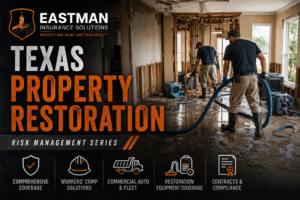
Workers’ Compensation Risks for Property Restoration Contractors