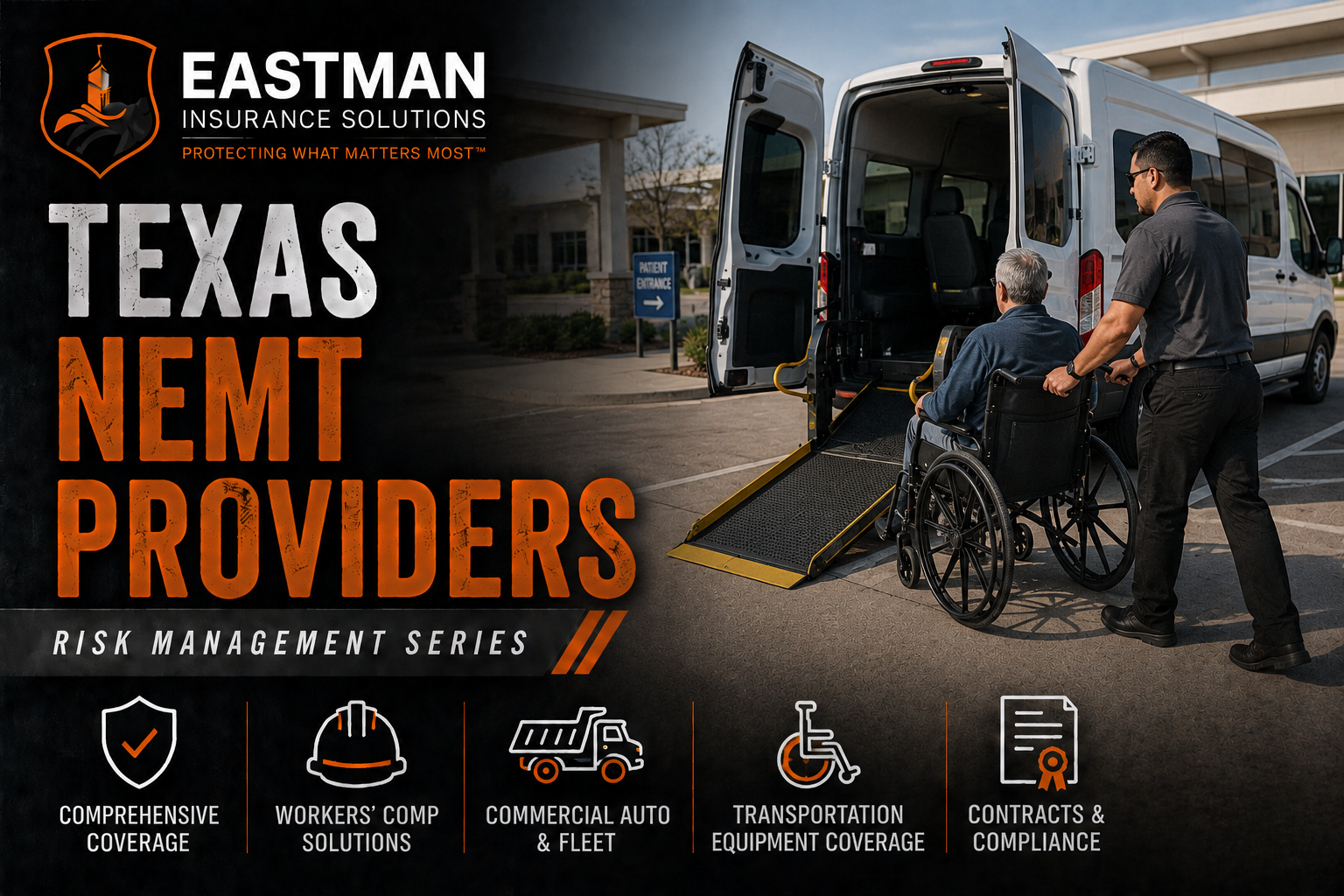
Non-Emergency Medical Transportation providers occupy an unusual position in the transportation industry.
They operate vehicles and employ drivers, but they are not simply transportation companies. Their passengers may be elderly, disabled, medically vulnerable, or dependent on mobility equipment. Drivers may assist passengers entering and exiting vehicles, secure wheelchairs, help individuals navigate steps or curbs, and interact with healthcare facilities, residential care providers, families, and other organizations responsible for the passenger’s wellbeing.
That combination creates risk well beyond an ordinary commercial auto exposure.
As a Texas NEMT provider grows, the operation can become substantially more complicated. A few vehicles become a fleet. More drivers are hired. Dispatch becomes more sophisticated. Contracts with facilities, managed transportation networks, healthcare organizations, or other referral sources become increasingly important. Wheelchair-accessible vehicles may become a larger part of the fleet, and ownership has less direct visibility into what individual drivers are doing throughout the day.
At that point, insurance should not be treated simply as the cost of putting vehicles on the road.
The stronger question is whether the organization’s insurance, driver management, passenger-safety procedures, claims practices, and contractual obligations have kept pace with the transportation operation it has built.
Growth Changes the NEMT Provider’s Ability to Control What Happens on the Road
A small NEMT operation can depend heavily on direct owner involvement.
Ownership may personally know every driver, review every vehicle, handle dispatch, communicate with passengers, and become involved immediately when something unusual occurs.
That level of visibility changes as the fleet grows.
Once multiple vehicles are operating throughout the day, the owner cannot personally observe how every driver handles a passenger, secures a wheelchair, responds to a schedule change, navigates traffic, or communicates after an incident.
The company begins depending on systems.
Driver qualification standards need to determine who is allowed behind the wheel. Training needs to establish how passengers should be assisted. Dispatch procedures need to account for changing schedules and trip requirements. Vehicle inspections need to happen consistently. Incidents need to be reported even when management isn’t there to witness them.
This is a critical transition for a growing NEMT provider.
The organization is moving from owner-controlled risk to system-controlled risk.
The companies that manage that transition well don’t simply hire more drivers and buy more vehicles. They build operating procedures capable of maintaining the organization’s standards as the number of trips increases.
Commercial Auto Is the Foundation, but the Driver Is the Exposure
For most NEMT providers, Commercial Auto Insurance is one of the most important components of the insurance program.
That makes sense.
Vehicles may operate for much of the day, drivers can accumulate substantial mileage, and passengers are routinely being transported through public traffic.
But the vehicle itself is only part of the exposure.
The person operating it matters just as much.
A serious collision involving an NEMT vehicle can potentially injure the driver, the passenger, occupants of another vehicle, pedestrians, or multiple parties simultaneously. When the passenger is medically fragile or has limited mobility, the consequences of an accident may be even more complicated.
This makes driver selection one of the most important risk-management decisions an NEMT company makes.
Hiring someone who possesses a valid driver’s license doesn’t necessarily mean that person represents an acceptable commercial driving risk.
Motor Vehicle Record reviews, driver eligibility standards, prior accident history, moving violations, license status, and ongoing monitoring should be considered as part of the company’s driver-management process.
As the fleet grows, those standards become more important—not less.
A company with two vehicles may know exactly who is driving them.
A company with twenty, fifty, or more vehicles needs a system that can answer the same question with confidence.
Passenger Safety Extends Beyond Avoiding an Automobile Accident
One of the defining differences between NEMT and many other transportation businesses is that a passenger can be injured without the vehicle ever being involved in a collision.
A driver may assist a passenger from a residence to the vehicle. The passenger may need help navigating a curb, ramp, or uneven surface. A wheelchair may need to be positioned and secured. The passenger may require assistance entering or exiting the vehicle at a medical facility.
An injury during any of those activities can create a claim.
That means passenger safety begins before the vehicle starts moving and continues after it stops.
For wheelchair transportation, securement practices deserve particular attention. A wheelchair and its occupant need to be properly secured using the vehicle’s equipment and the company’s established procedures. Drivers need to understand those procedures and follow them consistently rather than developing individual shortcuts over time.
The same principle applies to lifts and ramps.
Equipment can be properly maintained and still create risk if employees aren’t trained to use it correctly.
As an NEMT provider adds drivers, management should be asking whether every passenger receives the same basic standard of care regardless of which employee arrives to perform the trip.
That consistency becomes increasingly important as direct owner supervision decreases.
Vehicle Maintenance Is Both a Fleet Issue and a Passenger-Safety Issue
Vehicle maintenance matters in any commercial fleet.
For an NEMT provider, it has an additional dimension because passengers may depend on specialized equipment attached to the vehicle.
A mechanical breakdown can interrupt a normal business trip. For an NEMT passenger, it can potentially interfere with access to medical care, leave a vulnerable individual waiting for replacement transportation, or create complications for a facility or caregiver expecting the passenger at a particular time.
Wheelchair lifts, ramps, securement equipment, doors, seating systems, tires, brakes, and other vehicle components therefore deserve consistent attention.
The challenge is making sure maintenance practices scale with the fleet.
When an owner operates only a handful of vehicles, maintenance may be tracked informally. As the organization grows, informal processes become increasingly difficult to manage.
Preventive maintenance schedules, documented inspections, driver vehicle-condition reporting, and procedures for removing unsafe vehicles from service help create accountability.
This also gives management something valuable if a claim occurs: documentation showing how the company maintained the vehicle and responded to identified problems.
Insurance can respond financially to certain covered losses.
It cannot compensate for the absence of a basic fleet-maintenance system when that absence becomes part of the allegation against the company.
Drivers Can Be Injured While Assisting Passengers
NEMT drivers don’t simply sit behind the steering wheel.
Depending on the operation, employees may assist passengers with wheelchairs, walkers, ramps, vehicle entry and exit, and other mobility-related activities. Repetitive movement and awkward physical positioning can contribute to strains and other injuries.
Drivers can also be injured in automobile accidents or while working around vehicles in parking lots, residential properties, and healthcare facilities.
That makes Workers’ Compensation Insurance an important consideration for a growing NEMT organization.
But as with other lines of insurance, the policy is only one part of the strategy.
Management should understand where employee injuries are actually occurring.
If repeated injuries involve wheelchair assistance, passenger handling, slips and falls, or vehicle entry and exit, those losses may point toward an operational issue that deserves attention.
The goal isn’t simply to pay the Workers’ Compensation claim efficiently.
It is to determine whether the organization can prevent the next employee from being injured in the same way.
As the workforce expands, safety training, incident reporting, return-to-work practices, and claims management become increasingly important components of the overall risk program.
Driver Screening Should Continue After the Employee Is Hired
A common mistake in fleet management is treating the Motor Vehicle Record as a hiring document.
The company checks the applicant’s driving history when the employee is hired, puts the report in the personnel file, and assumes the issue has been addressed.
But driving records change.
An employee can receive moving violations after being hired. A license can be suspended. Accidents can occur outside of work. A pattern can develop that management won’t necessarily know about unless there is an ongoing review process.
For an NEMT company, that matters because driving is not incidental to the employee’s job.
It is the job.
An organization responsible for transporting vulnerable passengers should therefore consider driver qualification an ongoing management responsibility.
EIS’s broader risk-management Resource Menu can help organizations develop more formal safety and compliance practices as their operations expand. The principles behind driver screening, documented training, incident management, and employee safety are especially important when growth makes direct supervision increasingly difficult.
This is one area where future NEMT-specific content will go considerably deeper, because driver quality is one of the strongest controllable variables in a transportation company’s loss performance.
Documentation Matters When the Facts of an Incident Are Disputed
Not every claim begins with a major accident.
A passenger may allege that a driver failed to provide appropriate assistance. A facility may report an incident differently from the driver. A family member may raise concerns after a trip. A passenger may fall during loading or unloading.
When that happens, the organization needs to determine what actually occurred.
Documentation becomes extremely important.
Trip records, dispatch information, vehicle assignments, driver statements, incident reports, photographs when appropriate, and other contemporaneous information can help establish the facts while memories are still fresh.
The speed of reporting matters as well.
A driver who waits several days to tell management about an incident can make the situation considerably more difficult to investigate.
Growing organizations therefore need clear expectations regarding what constitutes a reportable incident and how quickly management needs to know about it.
This is especially important in businesses where employees spend most of their working day away from supervisors.
Management cannot respond to an incident it doesn’t know occurred.
A strong reporting culture gives the company an opportunity to investigate quickly, preserve information, communicate appropriately, and involve the insurance carrier when necessary.
Contracts Can Introduce Risk That Doesn’t Appear on the Vehicle
As NEMT companies grow, contractual relationships often become increasingly important.
The provider may transport passengers under agreements with healthcare organizations, transportation networks, facilities, government-related programs, or other organizations.
Those contracts can contain insurance requirements and other obligations that materially affect the company’s risk.
Required liability limits may increase. Additional insured provisions may be requested. Certain coverage forms may be required. The agreement may contain indemnification or other risk-transfer language.
The company should understand those requirements before committing to the contract.
A Certificate of Insurance doesn’t create coverage that isn’t contained in the policy, nor does it automatically resolve a contractual obligation the company has agreed to assume.
That makes contract review part of the broader insurance conversation.
The objective isn’t simply to prove that the NEMT provider carries insurance.
It is to understand whether the insurance program reasonably supports the obligations the company is accepting in order to obtain the business.
That becomes increasingly important as the organization pursues larger contracts.
Serious Auto Claims Can Quickly Reach Beyond Primary Liability Limits
Transportation businesses have a meaningful potential for severe liability claims.
One accident can involve several injured people. An NEMT vehicle may be carrying multiple passengers. Other vehicles can become involved. The severity can increase quickly.
For established providers operating larger fleets, Commercial Umbrella or Excess Liability Insurance may therefore become an important part of the overall liability strategy.
The appropriate limit shouldn’t be determined solely by what a contract requires.
Contractual requirements provide one data point.
Fleet size, passenger capacity, operating territory, vehicle use, financial assets, contractual relationships, and the organization’s broader exposure should also be considered.
A company shouldn’t automatically assume that the minimum liability limit necessary to secure a contract is the same amount appropriate to protect the organization.
As the business grows, the potential severity of a loss deserves increasing attention.
Claims History Is a Window Into the Transportation Operation
A growing NEMT provider can learn a great deal by looking beyond the total dollars on its loss runs.
Several rear-end accidents may indicate something different from several backing accidents.
Passenger falls during loading may point toward a different problem than wheelchair securement incidents.
Employee strains associated with passenger assistance may reveal another pattern entirely.
Each claim has its own facts, but collectively they can show management where risk is finding the organization.
This is why loss history shouldn’t simply be reviewed a few weeks before renewal when someone wants to know why the insurance premium increased.
Claims are operational information.
They can help management determine whether driver selection needs to change, training needs to improve, vehicle procedures need to be revised, or a particular type of incident deserves greater attention.
They can also affect how insurance underwriters evaluate the organization.
A company that can explain what happened, what it learned, and what it changed presents a very different risk-management story from a company that simply submits a loss run containing repeated accidents with no explanation.
A strong claims history is valuable. A strong response to a difficult claims history can also matter.
The Insurance Program Should Reflect the Transportation Company You’ve Built
There is a substantial difference between an owner operating a few vehicles and an established NEMT organization managing a significant fleet, multiple drivers, wheelchair transportation, healthcare relationships, and larger contracts.
The insurance program needs to recognize that difference.
Commercial Auto will typically be central to the strategy, but General Liability, Workers’ Compensation, Commercial Property where appropriate, Umbrella or Excess Liability, Cyber Liability, Employment Practices Liability, and other specialized coverage may also deserve consideration based on the organization.
The goal isn’t to assemble the longest possible list of insurance policies.
It is to understand the operation.
Who is driving? Who is being transported? What assistance is being provided? How are vehicles maintained? How are incidents reported? What contractual obligations has the organization accepted? What does the loss history tell management? Where could one serious event threaten the company financially?
Those questions help determine which risks should be reduced, which can be transferred, and which should be insured.
As the NEMT provider grows, that analysis should grow with it.
Beyond the Coverage™ for Texas NEMT Providers
At Eastman Insurance Solutions, we believe the strongest NEMT insurance strategy begins outside the insurance policy.
It begins with the transportation operation itself.
Driver qualification, fleet safety, passenger-assistance procedures, vehicle maintenance, claims reporting, contractual risk transfer, employee safety, and insurance should work together rather than being treated as separate issues.
Our approach follows a broader risk-management process:
Identify → Reduce → Transfer → Insure → Manage
Identify where the organization is exposed. Reduce the risks that can reasonably be controlled. Transfer appropriate risks through contracts and other mechanisms. Insure the financial exposures that need to be transferred to an insurance carrier. Then continue managing the program as the organization changes.
That’s what we mean by going Beyond the Coverage™.
For additional industry-specific guidance, visit the Texas NEMT Transportation Insurance & Risk Management Hub.
Frequently Asked Questions About NEMT Insurance in Texas
What insurance does a growing NEMT company need?
The appropriate insurance program depends on the organization’s vehicles, passenger population, employees, contracts, services, and operating structure.
Commercial Auto is typically a central coverage for NEMT providers. General Liability, Workers’ Compensation, Commercial Property, Umbrella or Excess Liability, Cyber Liability, Employment Practices Liability, and other coverage may also be appropriate depending on the operation.
The insurance program should be designed around the actual transportation exposure rather than assuming every NEMT company needs an identical package.
Why is NEMT commercial auto insurance different from ordinary business auto exposure?
Transporting passengers creates a different liability exposure from operating vehicles primarily to move employees, tools, or materials.
NEMT passengers may also have mobility limitations or other vulnerabilities that can increase the complexity of an accident. Vehicle type, passenger capacity, wheelchair transportation, driver history, mileage, loss experience, and operating practices can all influence how an insurer evaluates the risk.
How important are MVRs for NEMT drivers?
Motor Vehicle Records are an important component of driver qualification because driving is a core function of an NEMT employee’s job.
An MVR can provide information about violations, accidents, license status, and other driving history. Providers should also consider how driver eligibility will be monitored after hiring rather than viewing the MVR as a one-time employment document.
Why should NEMT companies document passenger incidents even when there is no vehicle accident?
Passenger injuries and allegations can occur during loading, unloading, wheelchair securement, or assistance outside the vehicle.
Prompt incident documentation can help management determine what occurred, preserve information, respond appropriately, and identify whether operating procedures need to change.
When should an NEMT provider increase its liability limits?
There isn’t a single fleet size or revenue threshold that automatically determines the appropriate limit.
Fleet growth, passenger capacity, contractual requirements, loss severity potential, assets, and the organization’s overall exposure should be considered. Established providers should evaluate whether primary liability limits and any Umbrella or Excess Liability protection remain appropriate as operations expand.
How can an NEMT company improve its insurance results?
Insurance results are influenced by more than shopping for a lower premium.
Driver selection, MVR monitoring, vehicle maintenance, employee training, passenger-safety procedures, claims management, loss history, and the quality of the information presented to underwriters can all affect how the organization is evaluated.
A stronger risk profile generally gives the company more options than relying solely on the insurance marketplace to solve operational loss problems.
Protect the Transportation Operation You’ve Built
An established NEMT provider has more at risk than its vehicles.
It has passengers depending on the organization for safe transportation, drivers representing the company throughout the day, employees, contracts, referral relationships, specialized vehicles and equipment, and a reputation built one trip at a time.
As the fleet grows, the systems protecting that organization need to grow with it.
Eastman Insurance Solutions helps Texas NEMT providers connect commercial insurance, driver qualification, fleet safety, passenger risk, claims strategy, contractual risk transfer, and operational risk management to the way their transportation businesses actually operate.
If your NEMT organization today looks very different from the company your insurance program was originally designed to protect, it may be time for a closer look.
Schedule a Risk Consultation →
Looking for more insurance tips?
- NEMT Insurance in Texas: What Growing Transportation Providers Need to Know
- Insurance for Texas Property Owners Who Lease Homes to IDD Care Providers
- Appliance Repair Business Insurance in Texas: Managing Risk as Your Company Grows
- Garage Door Company Insurance in Texas: What Service & Installation Businesses Need to Know
- Property Restoration Insurance in Texas: Protecting a Growing Restoration Company