
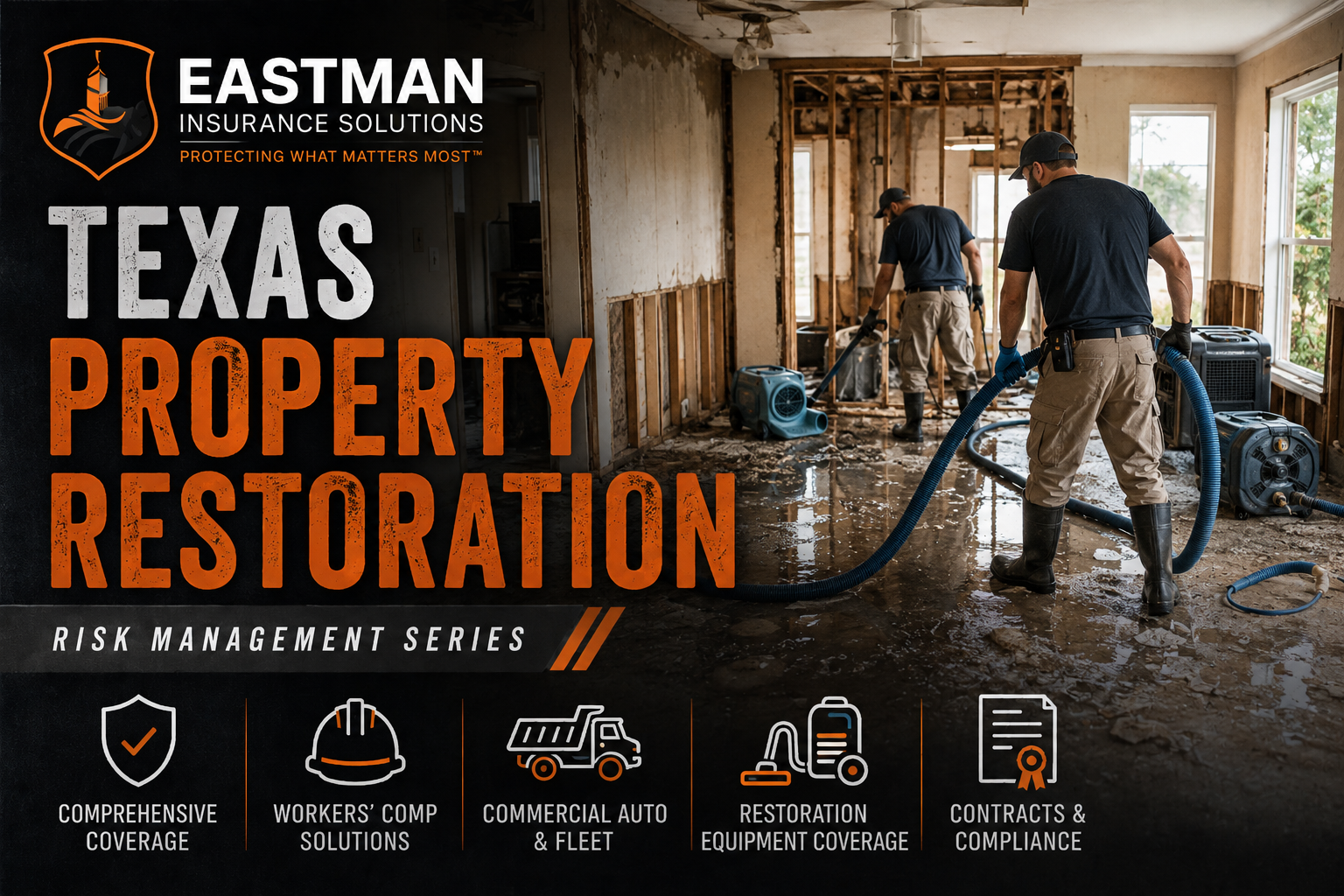
Property restoration contractors operate in an unusual environment.
Unlike many contractors, they often arrive after something has already gone wrong.
A pipe has burst. A building has flooded. Fire has damaged a structure. A storm has compromised a roof. Sewage has contaminated a property. Mold or microbial growth may be present. Structural components may be unstable, utilities may be damaged, and occupants may still be trying to understand what happened.
Restoration employees are then expected to enter that environment, assess conditions, stabilize the property, remove damaged materials, set equipment, document the loss, and begin putting the building back together.
That creates a workers’ compensation exposure fundamentally different from working on a controlled construction site.
For established Texas restoration contractors, managing employee injuries requires recognizing that the jobsite itself may be one of the biggest unknowns when the crew arrives.
Workers’ compensation insurance can help transfer the financial consequences of employee injuries. But controlling those injuries begins before the claim—with jobsite assessment, training, PPE, supervision, documentation, and the authority to stop when conditions are unsafe.
Restoration Crews Frequently Enter Uncontrolled Environments
A new-construction contractor typically begins work on a project where the scope and work environment are reasonably understood.
Restoration is different.
The contractor may receive an emergency call with limited information and dispatch a crew to a property it has never seen.
What caused the damage?
Is electricity still energized?
Has water affected electrical systems?
Is the structure stable?
Is contamination present?
Are ceilings or flooring compromised?
Are there hazardous materials?
Is standing water hiding additional hazards?
Is another contractor already performing work?
Those questions demonstrate why the initial jobsite assessment is so important.
The urgency of the loss should not eliminate the need to identify hazards before employees begin working.
Water Damage Creates More Than a Slip-and-Fall Exposure
Water mitigation is a core operation for many restoration companies.
The obvious exposure is slipping on wet surfaces.
But water losses can create much more complicated employee hazards.
Water may interact with electrical systems. Flooring may become unstable. Materials become heavier after absorbing moisture. Employees may move equipment through confined or obstructed spaces. Contaminated water may create biological exposure.
Employees may also repeatedly lift and reposition air movers, dehumidifiers, extraction equipment, hoses, damaged contents, flooring, drywall, and other materials.
The cumulative physical demand can produce strains and musculoskeletal injuries even when there is no dramatic accident.
That makes water mitigation both a jobsite-hazard problem and a material-handling problem.
Fire-Damaged Structures Introduce Multiple Layers of Risk
Fire restoration creates another set of conditions.
Employees may encounter soot, smoke residue, damaged structural components, debris, compromised flooring, damaged electrical systems, sharp objects, and materials affected by heat or suppression efforts.
A building that appears stable from the outside may contain hazards that aren’t immediately obvious.
The contractor therefore needs clear procedures governing when employees can enter, what assessment is required, what PPE is appropriate, and when additional expertise is necessary before work continues.
Production pressure matters here as well.
Property owners, adjusters, general contractors, and other parties may want mitigation to begin quickly.
But urgency cannot substitute for hazard assessment.
A restoration contractor needs employees and supervisors who understand that “start immediately” does not mean “start blindly.”
Contaminated Environments Require Exposure-Specific Controls
Some restoration losses involve more than damaged building materials.
Sewage, microbial growth, chemicals, smoke residue, and other contaminants can create employee exposure.
The appropriate controls depend on the actual hazard and scope of work.
That means PPE cannot simply be treated as a universal checklist.
Respiratory protection, gloves, protective clothing, eye protection, containment procedures, hygiene practices, and other controls need to match the work being performed.
Training matters just as much as having the equipment available.
A respirator sitting in a truck doesn’t control an exposure if the employee doesn’t understand when it is required, how it should be used, or whether the company’s respiratory-protection procedures are adequate for the work.
The Texas Regulatory Compliance & OSHA Resource Center provides additional resources for Texas employers evaluating workplace safety and compliance issues.
Demolition and Material Removal Create Frequent Injury Opportunities
Restoration often involves selective demolition.
Employees may remove drywall, flooring, insulation, cabinetry, damaged building materials, fixtures, or other components before reconstruction begins.
That creates exposures involving hand tools, power tools, sharp materials, falling debris, dust, repetitive motion, awkward positioning, and lifting.
The work may also occur in spaces that weren’t designed as construction sites.
Furniture, narrow hallways, stairs, occupied areas, damaged surfaces, and limited access can complicate otherwise routine tasks.
The safest procedure in an open construction environment may need to be adapted to the conditions inside an occupied or damaged property.
That makes field judgment important.
Employees need to understand both the procedure and when the environment requires them to stop and reassess.
Ladders, Roofs, and Elevated Work Can Increase Claim Severity
Storm and fire losses may require employees to inspect or work at elevation.
Ladders may be used for access. Employees may encounter damaged roofing systems, wet surfaces, temporary coverings, compromised decking, or unstable areas.
Falls can quickly become severe workers’ compensation claims.
The issue isn’t simply whether employees know how to use a ladder.
Management should understand which employees are permitted to perform elevated work, what training they receive, what equipment is available, and when conditions make the work inappropriate.
A restoration company’s scope can expand quickly after a major storm or catastrophe.
That is precisely when normal controls should become more important, not less.
Catastrophe Work Can Put Pressure on Normal Safety Systems
Major weather events can create extraordinary demand for restoration contractors.
Phones begin ringing.
Existing customers need immediate assistance.
New opportunities arrive.
Crews work longer hours.
Temporary labor may be added.
Employees travel farther.
Equipment moves constantly.
Supervisors become stretched.
Those conditions can create significant growth in revenue over a very short period—but they can also stress the company’s safety systems.
Fatigue becomes important.
New or temporary employees may not understand company procedures.
Vehicles spend more time on the road.
Supervisors may be responsible for more jobs than usual.
Documentation can deteriorate because everyone is focused on production.
The question during catastrophe response isn’t simply whether the company can accept more work.
It is whether the company’s risk-management systems can scale at the same speed as production.
New Employees Need Restoration-Specific Training
Prior construction experience can be valuable.
It does not automatically prepare an employee for restoration work.
A carpenter may understand tools and demolition but have limited experience with contaminated water.
A laborer may be physically capable but unfamiliar with respiratory hazards.
An employee may understand ladder safety but not recognize the risks associated with a fire-damaged structure.
That is why onboarding should reflect the actual exposures employees will encounter.
Training should address the company’s operations, equipment, PPE, hazard assessment, incident reporting, and the limits of what an employee is authorized to do.
This becomes particularly important when rapid growth or catastrophe response creates pressure to put new employees into the field quickly.
Supervisors Need the Authority to Stop Work
Restoration contractors operate in conditions that can change quickly.
A crew may begin demolition and discover something unexpected behind a wall.
Water removal may reveal damaged electrical components.
Employees may identify suspected hazardous material.
Structural conditions may be worse than initially believed.
A supervisor needs more than responsibility for completing the job.
The supervisor needs clear authority to stop the job when conditions fall outside the expected scope or established safety parameters.
That authority should be supported by management.
If employees believe they will be criticized for delaying production, the company’s written stop-work policy may mean very little in practice.
Fleet Risk and Employee Injury Risk Often Intersect
Restoration companies are mobile operations.
Employees drive trucks and vans between losses, transport equipment, respond to emergency calls, and may travel during severe weather conditions.
That creates obvious commercial auto exposure.
It also creates workers’ compensation exposure.
Employees may be injured in vehicle accidents while working. They may also be injured loading extraction equipment, moving dehumidifiers, unloading air movers, securing equipment, or carrying materials between vehicles and damaged properties.
During catastrophe response, increased mileage and fatigue can compound the exposure.
Fleet management and workers’ compensation should therefore not be viewed as completely separate risk categories.
They frequently originate from the same operational decisions.
Incident Reporting Is Critical When Jobsites Are Constantly Changing
A restoration contractor may have crews working at numerous unrelated properties on the same day.
If an employee is injured, management needs a reporting system capable of capturing what happened while the information is still available.
Where did the injury occur?
What was the employee doing?
What condition existed?
What equipment was involved?
Was PPE being used?
Who witnessed the incident?
Was the condition identified during the original assessment?
Did something change during the work?
Those details can become difficult to reconstruct days later.
Prompt reporting allows the company to address the employee’s injury while also determining whether the incident reveals a larger operational issue.
Claims Should Be Managed, Not Merely Reported
Reporting a workers’ compensation claim to the carrier does not end the contractor’s responsibility.
Management should remain engaged.
What is the employee’s current work status?
What restrictions exist?
Is treatment progressing?
Are reserves changing?
Is modified duty possible?
Was the cause of the incident investigated?
Were corrective measures implemented?
Does the same exposure exist on other jobs?
The EIS Claims Support Center provides resources for navigating the claims process, but the larger principle is straightforward:
A claim is both a financial event and operational information.
The company should learn from both.
Return-to-Work Can Be Difficult—but Valuable
Restoration work is often physically demanding.
An employee with temporary restrictions may be unable to perform demolition, carry equipment, climb ladders, or work in contaminated environments.
That doesn’t automatically mean the employee cannot perform productive work.
Depending on medical restrictions and the organization, temporary duties might include equipment inventory, documentation, warehouse organization, job-file support, vehicle or equipment records, training, administrative functions, or other appropriate work.
The available options will differ by company.
Planning for modified duty before a claim occurs gives management more options than trying to invent a solution after an employee has already been injured.
Loss Runs Can Reveal Where Operations Are Breaking Down
Workers’ compensation loss runs should be reviewed as operational data.
A restoration contractor might discover that strains are concentrated around equipment handling.
Perhaps newer employees experience a disproportionate number of injuries.
Maybe ladder incidents are increasing.
Perhaps one supervisor’s jobs generate more incidents than others.
Maybe catastrophe periods consistently produce more losses.
Or claims may simply remain open longer than management expects.
Those patterns don’t automatically prove the cause.
They tell leadership where to investigate.
The goal is to move from:
“We had another claim.”
to:
“Why are we having this type of claim?”
That is a much more useful management question.
Growth Changes the Workers’ Compensation Challenge
When a restoration contractor is small, the owner may personally inspect jobs, train employees, monitor equipment, and respond to incidents.
That becomes difficult as the company grows.
More crews mean more jobs occurring simultaneously.
More vehicles mean more time on the road.
More supervisors mean more opportunities for procedures to be interpreted differently.
More employees mean onboarding and training must become systematic.
Larger losses may involve more complicated environments.
Catastrophe work can accelerate all of this at once.
The business eventually reaches a point where employee safety cannot depend primarily on owner involvement.
It needs systems capable of producing consistent decisions when the owner isn’t on the jobsite.
For a broader look at these exposures, visit the Texas Property Restoration Insurance & Risk Management Hub.
Managing Workers’ Compensation as Part of the Restoration Risk Program
At Eastman Insurance Solutions, we approach risk through:
Identify → Reduce → Transfer → Insure → Manage
For restoration contractors, that means identifying hazards before employees begin work, reducing controllable exposures, transferring appropriate risks, structuring insurance around the actual operation, and actively managing claims and changing conditions.
Workers’ compensation is an important component.
But the policy responds after an injury.
The strongest opportunity exists earlier—in the decisions the company makes about jobsite assessment, employees, equipment, PPE, supervision, workload, and claims management.
The objective is to build a restoration company whose risk-management systems become stronger as the business grows.
Frequently Asked Questions About Workers’ Compensation for Restoration Contractors
Why are workers’ compensation exposures different for property restoration contractors?
Restoration employees frequently enter damaged properties where conditions may be unknown or changing. Water, electrical hazards, structural damage, contamination, demolition, ladders, equipment handling, and emergency-response conditions can create overlapping employee exposures on a single job.
What employee injuries should restoration contractors monitor?
The company’s own loss history should drive the analysis. Strains and material-handling injuries, slips and falls, cuts, ladder and elevation incidents, equipment-related injuries, vehicle-related events, and exposures associated with contaminated environments are among the areas worth evaluating.
How can catastrophe work affect workers’ compensation results?
Catastrophe response can rapidly increase workload, employee hours, driving, hiring, equipment use, and the number of active jobs. Fatigue, inexperienced employees, stretched supervisors, and inconsistent procedures can emerge when production expands faster than the company’s normal risk controls.
Why is the initial jobsite assessment important?
Restoration crews often arrive with incomplete information about the property. An initial assessment helps identify conditions such as electrical hazards, unstable materials, contamination, access issues, or other exposures before employees begin work.
Should restoration contractors review workers’ compensation loss runs throughout the year?
Yes. Regular review can help identify patterns involving specific injury types, employees, supervisors, operations, or periods of unusually high activity. It also allows management to monitor open claims and return-to-work opportunities before renewal.
Can a workers’ compensation claim indicate a larger operational problem?
Absolutely. Repeated injuries involving the same task, equipment, supervisor, or operating condition may indicate that training, procedures, equipment, supervision, or another control deserves attention. Claims data can be valuable operational intelligence when it is actively analyzed.
The Jobsite May Be Damaged. Your Safety System Shouldn’t Be.
Property restoration contractors are hired because they can bring order to damaged and unpredictable environments.
Their employee-safety systems should do the same thing.
Strong jobsite assessment, trained employees, appropriate PPE, capable supervisors, stop-work authority, prompt incident reporting, active claims management, and disciplined review of loss trends allow a restoration company to respond quickly without allowing urgency to dictate every decision.
As the company grows, those systems become increasingly important.
Eastman Insurance Solutions works with established Texas property restoration contractors to evaluate workers’ compensation as part of a broader insurance and risk-management strategy.
Schedule a Risk Consultation →