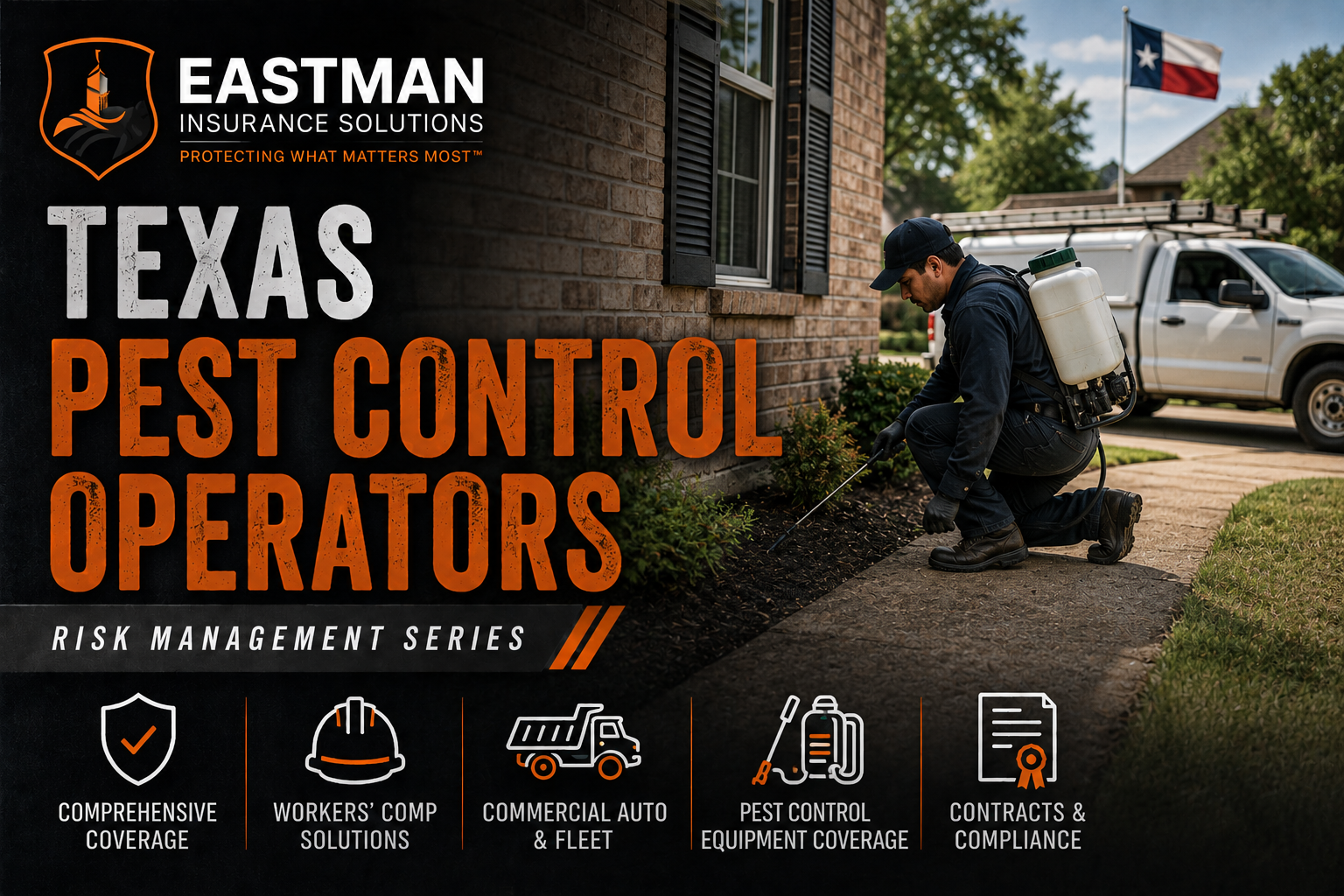
A successful pest control company can grow quickly. But as the operation expands, so does the company’s exposure to loss.
More technicians. More service vehicles. Larger routes. More customers. Commercial accounts. Specialized treatments. Additional locations.
A pest control business with multiple technicians operating independently throughout the day has a very different risk profile from a small owner-operated company.
Employees are driving company vehicles, entering customers’ homes and businesses, applying pesticides, handling equipment, working around animals, climbing into attics and crawl spaces, and making decisions away from direct supervision.
The insurance program needs to evolve with those operations.
At Eastman Insurance Solutions, we help Texas pest control companies look beyond individual insurance policies and understand how their people, vehicles, services, chemicals, customers, and claims all contribute to the company’s overall risk profile.
Here are some of the areas established pest control operators should be reviewing.
1. General Liability Needs to Reflect the Services You Actually Perform
“Pest control company” can describe very different operations.
One company may primarily provide residential recurring pest-control services.
Another may perform termite treatments, rodent exclusion, wildlife control, fumigation, mosquito treatments, commercial pest management, or specialized services.
Those differences matter.
General Liability Insurance is a foundational part of a pest control company’s insurance program, but the policy needs to accurately reflect the company’s actual operations.
As services expand, operators should review:
- Residential versus commercial operations
- Types of pests being treated
- Chemicals and pesticides being applied
- Termite operations
- Rodent or wildlife services
- Exclusion and repair work
- Subcontracted services
- Customer contracts
- Additional insured requirements
- Policy exclusions and limitations
Adding a new service isn’t simply a marketing decision.
It can change the company’s insurance exposure.
2. Pollution Liability Is a Significant Pest Control Exposure
This is one of the areas where pest control differs substantially from many other service businesses.
Pesticides and chemicals are part of the operation.
A technician can apply the correct product and still potentially face an allegation involving contamination, overspray, improper application, environmental damage, or exposure to people or animals.
Traditional General Liability policies may contain pollution exclusions or limitations.
That makes Contractors Pollution Liability Insurance particularly important to evaluate.
Potential exposures can involve:
- Pesticide application
- Chemical spills
- Overspray
- Contamination
- Improper disposal
- Transportation of chemicals
- Indoor air concerns
- Exposure allegations
- Environmental cleanup
The question isn’t simply whether the company follows application requirements.
The insurance question is:
What happens when a customer or third party alleges that your application caused bodily injury, property damage, or contamination?
For pest control operators, pollution liability shouldn’t be an afterthought.
3. Your Technicians May Spend More Time Driving Than Treating
Pest control is fundamentally a mobile service business.
Technicians may visit numerous customer locations during a single workday.
That creates substantial driving exposure.
As the company adds technicians, it usually adds vehicles—and eventually the fleet becomes one of the company’s largest potential sources of severe claims.
Commercial Auto Insurance transfers part of that risk.
Fleet management addresses the rest.
Established pest control companies should consider:
- Pre-employment driver screening
- Motor Vehicle Record reviews
- Driver eligibility standards
- Distracted-driving policies
- Vehicle-use rules
- Personal use of company vehicles
- Accident-reporting procedures
- Driver training
- Telematics where appropriate
- Corrective action following driving violations
One serious automobile accident can dwarf the cost of many routine pest-control claims.
The best commercial auto claim is still the one that never happens.
4. Workers’ Compensation Losses Can Develop in Unexpected Ways
Pest control technicians encounter a broad range of employee injury exposures.
They drive extensively.
They climb ladders.
They enter attics and crawl spaces.
They lift equipment.
They work in heat.
They encounter animals, insects, chemicals, uneven surfaces, and unfamiliar customer properties.
As technician count grows, Workers’ Compensation Insurance becomes increasingly important to the company’s overall cost of risk.
Operators should monitor:
- Claim frequency
- Claim severity
- Open claims
- Claim reserves
- Experience modification
- Return-to-work practices
- Injury-reporting procedures
- Recurring causes of employee injuries
Don’t simply ask:
“How much is our Workers’ Comp renewal?”
Ask:
“Why are our employees getting hurt?”
The second question gives you something you can potentially control.
5. Working Inside Customer Property Creates Unique Liability
Pest control technicians routinely enter places most other businesses don’t.
Homes.
Bedrooms.
Kitchens.
Restaurants.
Warehouses.
Medical facilities.
Schools.
Offices.
Commercial buildings.
Technicians may work around customers’ furniture, electronics, inventory, pets, landscaping, and other property.
That creates opportunities for allegations involving:
- Property damage
- Chemical damage
- Staining
- Contamination
- Improper treatment
- Damage while accessing treatment areas
- Customer injuries
- Pet exposure
- Lost or damaged property
Training should therefore extend beyond pesticide application.
Technicians should understand how to document conditions, communicate with customers, follow treatment protocols, and report incidents.
As the business grows, consistent procedures become increasingly important because the owner can no longer personally supervise every service call.
6. Tools and Equipment Still Need Protection
Pest control may not involve the same heavy equipment exposure as a construction contractor, but technicians still carry valuable business property.
That can include:
- Sprayers
- Foggers
- Application equipment
- Termite equipment
- Inspection equipment
- Ladders
- Power tools
- Wildlife equipment
- Electronic devices
- Specialized treatment equipment
Inland Marine Insurance can help protect certain tools, mobile equipment, and business property while away from the company’s primary location.
As the fleet grows, consider how much equipment may be distributed across company vehicles at any given time.
One vehicle theft can potentially mean losing both the truck and the equipment required for a technician to work.
7. Commercial Accounts Can Bring More Complicated Contracts
Growing pest control companies often begin pursuing larger commercial customers.
Property managers, restaurants, hospitality businesses, healthcare organizations, municipalities, school districts, industrial operations, and other commercial clients may impose insurance requirements that aren’t common in residential service agreements.
Requirements can include:
- General Liability limits
- Commercial Auto
- Workers’ Compensation
- Umbrella or Excess Liability
- Pollution Liability
- Additional insured status
- Primary and noncontributory wording
- Waivers of subrogation
- Specific endorsements
The time to understand those requirements is before the contract is signed.
Winning a large account only to discover afterward that your insurance program cannot satisfy the agreement creates an unnecessary problem.
8. Documentation Becomes More Important as Technician Count Grows
When an owner performs most of the work, the owner knows what happened.
That changes as the company grows.
With multiple technicians completing service calls throughout the day, documentation becomes one of the company’s most important risk-management tools.
Good records may include:
- Service performed
- Products applied
- Application locations
- Quantities or concentrations where appropriate
- Customer instructions
- Conditions observed
- Customer concerns
- Follow-up recommendations
- Photographs where appropriate
- Technician identification
- Date and time of service
Documentation doesn’t prevent every claim.
But when someone alleges months later that a treatment damaged property, caused an exposure, or wasn’t performed correctly, good records can become extremely valuable.
9. Cyber Risk Exists Even If You’re Not a Technology Company
Modern pest control businesses depend heavily on technology.
Scheduling platforms.
Customer databases.
Online payments.
Email.
Mobile applications.
Cloud-based service records.
Employee information.
Credit card information.
A pest control company doesn’t need an IT department to experience a cyber incident.
Cyber Liability Insurance can help address certain financial and liability exposures associated with covered cyber incidents, data breaches, ransomware, and technology disruptions.
But insurance should be paired with basic controls such as:
- Multi-factor authentication
- Strong access controls
- Employee phishing awareness
- Software updates
- Secure backups
- Appropriate vendor management
As the customer database grows, the company’s digital exposure grows with it.
10. Growth Can Require Higher Liability Limits
A pest control company with several technicians, a handful of vehicles, and mostly residential customers has one level of potential loss.
A larger operation with dozens of technicians, a substantial fleet, commercial accounts, multiple locations, and significant contracts has another.
As the company grows, Commercial Umbrella and Excess Liability Insurance can provide additional limits above certain underlying policies.
Commercial customers may dictate minimum umbrella limits.
But contractual requirements shouldn’t be the only consideration.
The company should also ask:
How much financial exposure are we trying to protect?
A growing business generally has more assets, revenue, employees, customers, and enterprise value at risk when a severe claim occurs.
Growth Changes the Pest Control Risk Profile
One of the biggest changes that occurs as a pest control company grows is loss of direct owner control.
The owner isn’t driving every vehicle.
The owner isn’t performing every treatment.
The owner isn’t speaking with every customer.
The owner isn’t personally supervising every technician.
That isn’t a criticism.
It’s what happens when a business successfully scales.
But it means systems and procedures become increasingly important.
Driver standards.
Technician training.
Chemical-handling procedures.
Incident reporting.
Documentation.
Claims management.
Customer communication.
Insurance.
These aren’t independent issues.
Together, they form the company’s risk-management system.
What Should a Growing Pest Control Company Review?
If your pest control company has added technicians, vehicles, services, locations, or larger commercial accounts, consider reviewing:
- Whether policies accurately describe current services
- General Liability coverage
- Pollution Liability
- Fleet size and driver controls
- Workers’ Compensation loss performance
- Open claims and reserves
- Technician training
- Treatment documentation
- Tools and mobile equipment
- Commercial contract requirements
- Cyber exposure
- Umbrella and Excess Liability limits
The objective isn’t simply to purchase additional policies as the business grows.
The objective is to understand how growth is changing the company’s risk and determine what should be reduced, retained, transferred, or insured.
Beyond the Coverage™ for Texas Pest Control Operators
At Eastman Insurance Solutions, we believe established pest control companies need more from an insurance relationship than an annual quoting exercise.
Our approach begins with understanding how the operation actually works.
Identify Risk → Reduce Risk → Transfer Remaining Risk
That can involve insurance placement, fleet management, Workers’ Compensation performance, pollution exposure, technician safety, claims advocacy, contract considerations, and ongoing review as the business changes.
The goal isn’t simply to insure your pest control company.
It’s to help protect what you’ve built.
For additional resources specifically developed for pest control businesses, visit the Texas Pest Control Business Insurance & Risk Management Hub.
Frequently Asked Questions About Pest Control Business Insurance in Texas
What insurance should an established pest control company carry?
There isn’t one insurance package appropriate for every pest control operation.
Depending on the business, coverage may include General Liability, Pollution Liability, Workers’ Compensation, Commercial Auto, Commercial Property, Inland Marine, Umbrella or Excess Liability, Cyber Liability, and other specialized insurance.
The appropriate program depends on the company’s services, technicians, vehicles, chemicals, customers, contracts, locations, and loss exposures.
Why is Pollution Liability important for pest control companies?
Pest control businesses apply and transport pesticides and other chemicals that can potentially create contamination, bodily injury, property damage, or environmental allegations.
General Liability policies may contain pollution exclusions or limitations, making it important to evaluate whether separate Pollution Liability coverage is appropriate.
How can a pest control company reduce Commercial Auto losses?
Start with driver management.
Pre-employment screening, Motor Vehicle Record reviews, documented driver standards, distracted-driving policies, accident reporting, training, and appropriate use of telematics can all contribute to stronger fleet performance.
How can pest control companies control Workers’ Compensation costs?
Look at what is actually causing employee injuries.
Driving accidents, falls, animal encounters, lifting injuries, heat exposure, chemical incidents, and other recurring loss patterns can help identify where risk-management efforts should be focused.
When should a pest control company review its insurance program?
Whenever the operation changes materially.
Adding technicians, vehicles, new services, locations, commercial contracts, or significant equipment can change the company’s exposure before the next insurance renewal arrives.
Protect the Pest Control Business You’ve Built
A growing pest control company has more than insurance policies to protect.
It has technicians, vehicles, customers, equipment, contracts, data, reputation, and years of work invested into building the operation.
Eastman Insurance Solutions helps Texas pest control companies connect commercial insurance, risk management, and claims strategy to the way their businesses actually operate.
If your company has grown but your insurance program hasn’t evolved with it, it may be time for a closer look.
Schedule a Risk Consultation →
Looking for more insurance tips?
- Workers’ Compensation Risks for Property Restoration Contractors
- Why Workers’ Compensation Claims Are Different in Residential IDD Care
- Workers’ Compensation for Asphalt Contractors: Managing High-Hazard Operations
- Workers’ Compensation for Landscaping Companies: Controlling Crew Injuries
- Workers’ Compensation for Electrical Contractors: Managing Field Risk