
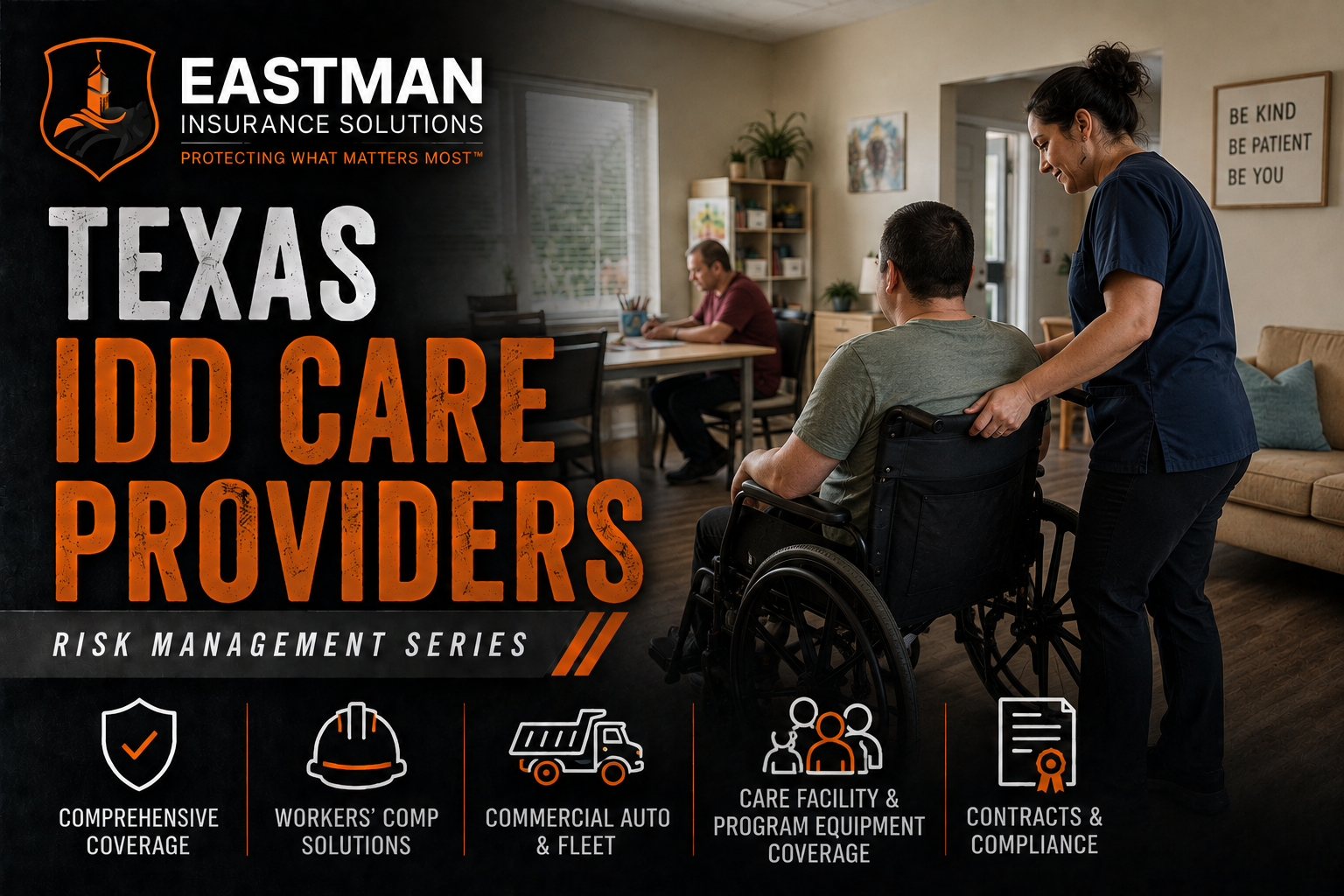
Workers’ compensation in residential IDD care looks very different from workers’ compensation in construction, manufacturing, or many traditional service businesses.
Employees aren’t simply performing physical tasks.
They are supporting people.
Direct support professionals and other care staff may assist individuals with activities of daily living, transfers, mobility, transportation, meals, medication routines, behavioral support, housekeeping, and community activities. They may work in residential environments around the clock, sometimes with limited immediate supervision.
That creates an unusual combination of employee injury exposures.
A back strain from assisting a resident may begin as a straightforward workers’ compensation claim. An incident involving aggressive behavior can involve both an employee injury and questions surrounding the care provided to the resident. A vehicle accident may involve an employee, a resident, commercial auto coverage, and workers’ compensation simultaneously.
For established Texas IDD providers, controlling workers’ compensation therefore requires more than a generic workplace safety program.
It requires understanding how care delivery, staffing, supervision, documentation, claims management, and employee safety intersect.
Employee Safety and Resident Care Cannot Be Separated
One of the defining characteristics of residential IDD operations is that risk management has two audiences:
the individual receiving care and the employee providing it.
Procedures designed to protect one can directly affect the other.
Consider resident transfers.
A transfer procedure exists partly to protect the resident from being dropped or injured. But proper technique, appropriate assistance, and available equipment also protect the employee from strains and musculoskeletal injuries.
Behavioral-support procedures may be designed primarily around resident safety and dignity, while also affecting an employee’s exposure to being struck, bitten, kicked, scratched, or otherwise injured.
Transportation procedures protect residents while also creating employee driving exposure.
That interconnectedness is why workers’ compensation should not operate independently from the provider’s broader risk-management program.
Lifting, Transfers, and Physical Assistance Can Produce Serious Claims
Residential care can be physically demanding even though it doesn’t resemble a traditional labor-intensive workplace.
Employees may help individuals transfer between beds, chairs, bathrooms, vehicles, and other locations. They may provide mobility assistance, reposition individuals, or respond when someone begins to fall.
The exposure varies significantly based on the population being served.
The important question is not simply whether employees have been trained in lifting.
Providers should evaluate whether staffing levels, resident needs, equipment, physical environment, and actual field practices support the procedures employees are expected to follow.
An employee who knows the correct procedure may still attempt a transfer alone if assistance isn’t readily available.
That is where a written safety procedure becomes an operational issue.
If the business grows to multiple homes, the challenge increases because management must make sure those expectations remain consistent at every location.
Behavioral Incidents Create a Different Employee-Injury Exposure
Employees working with individuals with intellectual and developmental disabilities may encounter behavioral situations that aren’t present in most workplaces.
The exposure will vary enormously from one provider and individual to another, so it should never be generalized across the entire IDD population.
Where behavioral challenges do exist, however, providers need to evaluate employee safety as part of the care environment.
Training, staffing, individual support plans, escalation procedures, communication, documentation, and post-incident review can all influence what happens before and after an event.
The objective isn’t simply preventing an employee injury.
It is supporting the individual appropriately while reducing avoidable risk to everyone involved.
That makes behavioral incidents a particularly good example of why residential IDD risk cannot be divided neatly into separate insurance-policy categories.
The Residential Environment Creates Its Own Workplace Hazards
A residential care home is simultaneously someone’s home and someone else’s workplace.
That distinction matters.
Employees may encounter wet floors, bathrooms, kitchens, stairs, furniture, outdoor areas, uneven surfaces, resident belongings, and other everyday household conditions.
Because the environment feels familiar, hazards can be easy to normalize.
Yet slips, trips, falls, strains, and other routine injuries can become meaningful workers’ compensation losses when multiplied across employees and locations.
Providers should therefore evaluate the physical environment through both lenses:
Is this environment appropriate and safe for the resident?
And:
Is this also a safe workplace for the employee?
Those aren’t always the same question.
Staffing Conditions Can Influence Workers’ Compensation Results
Employee injury risk cannot be evaluated without considering staffing.
When a provider is short-staffed, remaining employees may work longer hours, cover additional shifts, or perform tasks without the assistance normally available.
Fatigue can affect judgment and physical performance.
An employee may attempt a transfer alone.
A behavioral situation may be managed with fewer staff members than anticipated.
Housekeeping or maintenance issues may receive less attention.
Incident documentation may be delayed because employees are focused on immediate care responsibilities.
None of that means an injury was caused simply by staffing levels.
It does mean staffing conditions can affect the environment in which injuries occur.
For growing providers, workforce management and employee safety are closely connected.
New-Hire Training Has to Reflect the Actual Care Environment
Residential IDD providers frequently hire employees with very different levels of experience.
Some may have years of direct-care experience. Others may be entering the field for the first time.
Orientation should establish more than administrative expectations.
Employees need to understand the provider’s procedures for the actual situations they may encounter: transfers, mobility assistance, behavioral incidents, transportation, emergencies, documentation, reporting injuries, and the specific needs of the individuals they support.
Training also has to continue after orientation.
The employee’s first several weeks in the home can reveal whether classroom or online instruction translated into safe field behavior.
As providers add homes and supervisors, consistency becomes increasingly important.
A company does not have one safety culture if each location teaches employees something different.
Transportation Can Create Multiple Claims From One Event
Many residential IDD providers transport individuals to appointments, employment programs, community activities, shopping, recreation, or other destinations.
That creates commercial auto exposure, but it also creates employee injury exposure.
An employee injured while driving or otherwise acting within the course and scope of employment may create a workers’ compensation claim. If a resident is also injured, the same event may involve additional liability and insurance considerations.
Loading, unloading, mobility assistance, wheelchair securement where applicable, entering and exiting vehicles, and roadside situations can also expose employees to injury without a collision occurring.
For that reason, fleet management should not be isolated from the workers’ compensation program.
Driver qualification, MVR monitoring, vehicle procedures, training, accident response, and incident reporting are all pieces of the broader risk picture.
Overnight and 24-Hour Operations Change Supervision
Residential care doesn’t necessarily stop at 5:00 p.m.
Some providers operate continuously.
That means an employee injury may occur late at night, on a weekend, or when senior management isn’t immediately available.
The organization needs a reporting process that works regardless of when an incident occurs.
Who does the employee contact?
Who determines whether medical attention is needed?
Who documents what happened?
Who communicates with management?
What happens when a resident was involved in the incident?
What additional reporting requirements may apply?
Those questions should be answered before the event occurs.
A procedure that works only during normal office hours isn’t sufficient for a 24-hour operation.
Documentation Matters for More Than the Workers’ Compensation Claim
Documentation is especially important in residential care because one incident may touch several parts of the organization.
Consider an employee who is injured during an interaction with a resident.
The workers’ compensation claim may require information about the employee’s injury.
The provider may separately need documentation regarding what happened to or involved the resident.
Management may need to determine whether procedures were followed.
There may also be contractual, regulatory, internal, or other reporting obligations depending on the circumstances.
Those processes should be coordinated, but they should not be treated as interchangeable.
Good documentation helps preserve the facts while allowing the organization to evaluate the event from multiple perspectives.
A Claim Should Trigger More Than an Insurance Report
Reporting the workers’ compensation claim is only one step.
Management should also ask what the event reveals about the operation.
Was the employee properly trained?
Was adequate assistance available?
Were established procedures followed?
Did the physical environment contribute?
Was fatigue a factor?
Did a behavioral situation develop differently than anticipated?
Was the incident reported promptly?
Has something similar happened before?
Those questions turn claims into risk-management information.
The EIS Claims Support Center provides resources surrounding claims, but the broader objective is to prevent the claims process from becoming disconnected from operational improvement.
Return-to-Work Requires Planning in a Direct-Care Environment
Return-to-work can be difficult for residential care providers because many positions involve physical assistance and direct interaction with residents.
An employee with temporary lifting restrictions, for example, may be unable to perform normal direct-support duties safely.
That doesn’t necessarily mean no productive work is available.
Depending on the organization and the employee’s medical restrictions, temporary duties might involve training, administrative support, documentation, scheduling assistance, inventory, records review, or other appropriate functions.
The specific solution will vary.
What matters is establishing a process before a claim occurs.
Modified duty should never create additional risk for the employee or compromise the quality or safety of resident care.
Loss Runs Can Reveal Problems Across Homes, Shifts, and Supervisors
For a multi-location IDD provider, workers’ compensation loss runs can provide valuable operational information.
Looking only at total claim dollars can hide the story.
Management should consider whether claims cluster around particular locations, shifts, supervisors, job functions, activities, or types of incidents.
Perhaps transfer-related injuries are concentrated in one home.
Perhaps newer employees account for a disproportionate number of claims.
Perhaps behavioral incidents are producing recurring employee injuries.
Perhaps claims reported on overnight shifts consistently reach management later.
Patterns don’t automatically establish the cause.
They tell management where to ask better questions.
The strongest providers use insurance data as another source of operational intelligence.
Workers’ Compensation Costs Can Extend Beyond the Claim
An injured direct-support employee creates consequences beyond medical bills and indemnity payments.
Other employees may work overtime.
A supervisor may need to cover shifts.
The provider may need temporary staffing.
Schedules may change.
Employee morale can be affected.
Management spends time coordinating the claim.
Most importantly, staffing disruptions can affect continuity of care.
Workers’ compensation performance can also influence future underwriting and insurance costs.
That is why the objective should be broader than reducing premium.
The goal is controlling the total organizational cost of employee injury while maintaining appropriate resident care.
Growth Requires Systems That Work Across Every Home
When a provider operates one residence, leadership may have significant direct knowledge of employees, residents, and daily operations.
That changes as the organization grows.
Additional homes create additional employees, supervisors, shifts, vehicles, environments, and opportunities for procedures to drift.
At that stage, risk management has to become systematic.
Hiring.
Training.
Supervision.
Transfer procedures.
Behavioral-support practices.
Transportation.
Incident reporting.
Claims management.
Return-to-work.
Loss analysis.
The objective isn’t creating paperwork for its own sake.
It is making sure the organization’s standards remain recognizable from one home and one shift to the next.
For broader guidance on insurance and operational risk in this sector, visit the Texas IDD Care Provider Insurance & Risk Management Hub.
Managing Workers’ Compensation as Part of the IDD Risk Program
At Eastman Insurance Solutions, we approach risk through:
Identify → Reduce → Transfer → Insure → Manage
For residential IDD providers, that means understanding where employee injuries intersect with care delivery, reducing preventable exposures, transferring appropriate risks, structuring insurance around the organization, and actively managing claims and changing conditions.
Workers’ compensation insurance remains an important part of that strategy.
But the policy sits downstream from staffing, training, supervision, documentation, transportation, and daily care practices.
The objective is not simply to insure employee injuries.
It is to build an organization capable of protecting employees while continuing to protect the individuals they serve.
Frequently Asked Questions About Workers’ Compensation for Residential IDD Care Providers
Why are workers’ compensation claims different for residential IDD providers?
Employees work in residential environments while providing direct support to individuals. Injuries can arise from transfers, mobility assistance, behavioral incidents, slips and falls, transportation, and other care-related activities. An event may also involve resident safety or other organizational responsibilities, making the circumstances more complex than a typical workplace injury.
What employee injuries should IDD providers monitor most closely?
Providers should begin with their own loss history. Depending on the population served and services provided, areas worth evaluating can include strains from transfers or physical assistance, slips and falls, injuries associated with behavioral incidents, transportation-related injuries, and other recurring patterns within particular homes or shifts.
Can staffing shortages affect workers’ compensation risk?
They can influence the conditions in which employees work. Short staffing may contribute to longer shifts, fatigue, reduced assistance for physical tasks, or inconsistent execution of procedures. Providers should evaluate staffing as one component of the broader employee-safety environment rather than assuming every injury has a single cause.
Why should an IDD provider analyze claims by location and shift?
Organization-wide totals can conceal patterns. Looking at claims by home, shift, supervisor, employee tenure, or activity can help management identify where further investigation, training, supervision, or operational changes may be appropriate.
How should a provider handle an incident involving both an employee and a resident?
The employee injury and the resident-related incident may create different reporting, documentation, insurance, regulatory, or organizational responsibilities. Providers should have procedures for preserving the facts and coordinating the appropriate processes without assuming one report satisfies every obligation.
Can return-to-work be used for direct-support employees?
Potentially, depending on the employee’s medical restrictions and the duties available. Any modified assignment should comply with medical restrictions and should not create additional employee risk or compromise resident care. Planning possible assignments before a claim occurs can make the process easier to manage.
Protecting the People Who Provide the Care
Residential IDD providers exist to support people.
The employees delivering that support are central to the mission.
As an organization grows, protecting those employees requires more than purchasing workers’ compensation insurance. It requires consistent training, capable supervision, appropriate staffing practices, effective incident reporting, engaged claims management, and the ability to learn from losses across homes and shifts.
The strongest risk-management strategy protects both sides of the care relationship.
Eastman Insurance Solutions works with established Texas IDD providers to evaluate workers’ compensation as part of a broader insurance and risk-management strategy built around the realities of residential care.
Schedule a Risk Consultation →
Continue Exploring IDD Care Risk Management
- Key Insurance Coverages for IDD Residential Care Facilities in Texas (By Region)
- 5 Common Insurance Gaps That Put Texas Residential Care Facilities at Risk
- Cyber Liability for Residential Care Facilities: The Risk No One Talks About
- Why Texas Residential Care Facilities Are Looking To Group Captives
- Insurance and Risk Management for Texas IDD Care Providers