
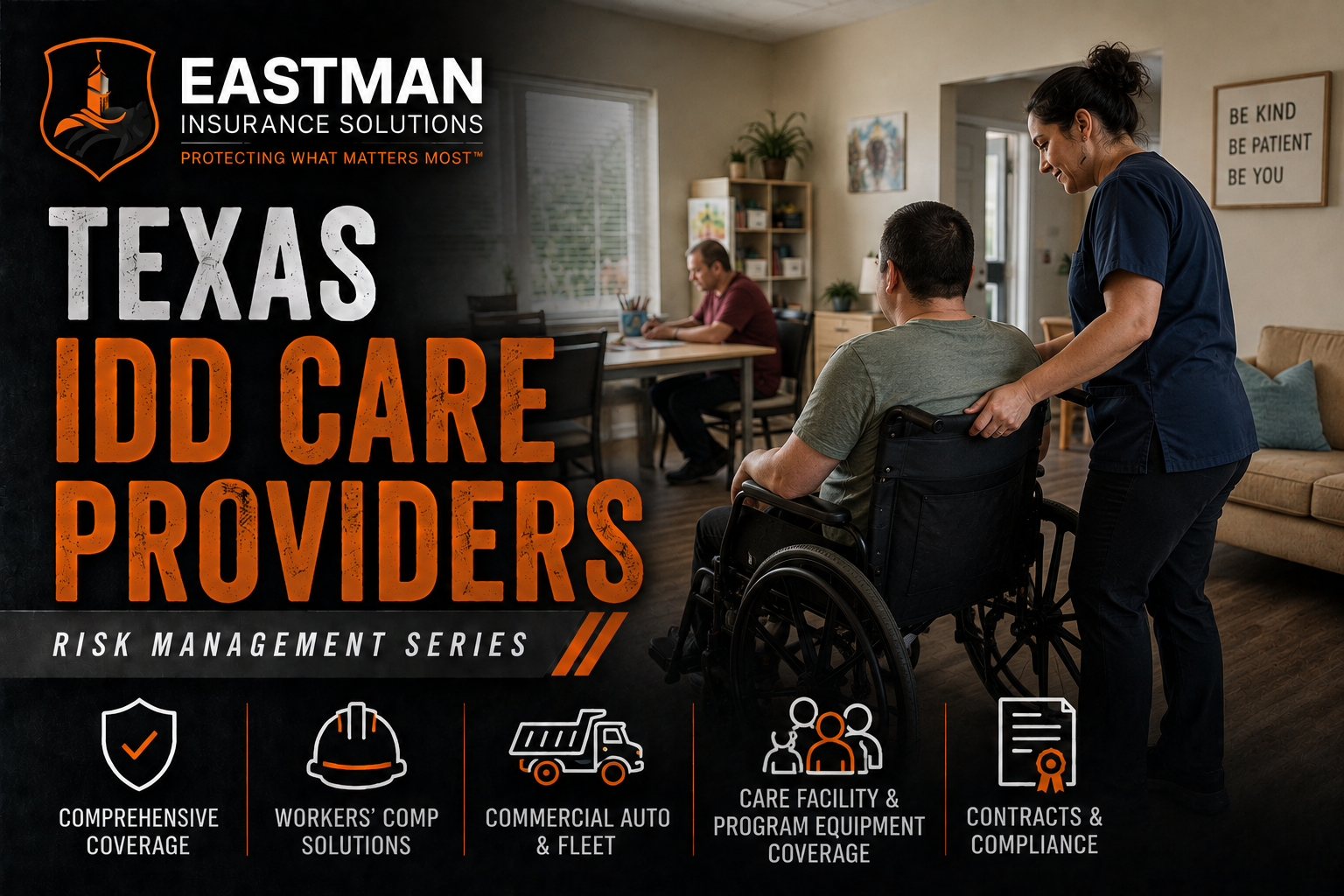
Providing residential services to individuals with intellectual and developmental disabilities creates a risk profile unlike most other businesses.
Employees aren’t simply working at a company location.
They are providing care and supervision, assisting individuals with daily activities, administering or supporting medication processes, transporting clients, responding to behavioral incidents, and operating across residential environments that may function 24 hours a day.
For established IDD organizations operating multiple homes, those exposures become increasingly interconnected.
A client incident can involve Professional Liability.
An employee injured during a behavioral event can become a Workers’ Compensation claim.
A transportation accident can involve Commercial Auto and potentially Umbrella coverage.
An allegation involving client treatment can trigger Professional Liability or Abuse and Molestation coverage.
A fire or water loss at a residential facility can affect the property itself while simultaneously disrupting services for the individuals living there.
This is why insurance for an IDD care provider shouldn’t be treated as a collection of unrelated policies.
At Eastman Insurance Solutions, we help Texas IDD providers evaluate insurance, employee risk, client safety, transportation, property, claims, and operational risk as parts of the same organization.
Here are some of the areas established IDD care providers should be evaluating.
1. General Liability Is Only One Piece of the Liability Program
General Liability Insurance remains an important foundation of an IDD provider’s insurance program.
It can respond to certain claims involving third-party bodily injury and property damage arising from the organization’s operations.
But an IDD provider’s most significant liability exposures may extend beyond traditional premises liability.
Organizations should evaluate exposures involving:
- Clients and visitors
- Residential locations
- Property damage
- Transportation
- Professional services
- Employee actions
- Client supervision
- Medication processes
- Behavioral incidents
- Abuse and molestation allegations
- Management decisions
The important distinction is that not every allegation involving an IDD provider fits neatly within General Liability coverage.
That’s why the liability program needs to be evaluated as a whole.
2. Professional Liability Is Central to the Care Exposure
IDD providers don’t simply maintain residential properties.
They provide services to people.
That creates professional exposure.
An allegation could involve:
- Failure to properly supervise
- Failure to follow a care plan
- Inadequate documentation
- Medication-related errors
- Failure to respond appropriately to an incident
- Improper implementation of procedures
- Negligent care
- Failure to protect a client from harm
Professional Liability Insurance can help address certain claims alleging errors, omissions, or negligence in the professional services provided by the organization.
As an IDD provider grows, consistency becomes increasingly important.
Policies may be established at the organizational level, but employees must carry them out across multiple homes and shifts.
The larger the organization becomes, the more important standardized procedures, documentation, training, and supervision become.
3. Abuse and Molestation Coverage Requires Careful Attention
Few allegations carry greater potential consequences for a care organization than abuse or molestation.
The consequences can extend far beyond the insurance claim.
An allegation can affect:
- The individual receiving services
- Employees
- Management
- Regulatory relationships
- Family relationships
- Organizational reputation
- Future operations
IDD providers should understand how their insurance program addresses allegations involving abuse, molestation, mistreatment, or inappropriate conduct.
Important considerations can include:
- Coverage limits
- Sublimits
- Defense provisions
- Policy exclusions
- Employee versus client allegations
- Background-screening practices
- Incident-reporting procedures
- Staff training
- Supervision
- Documentation
This is an area where simply seeing a line item on an insurance proposal isn’t enough.
The actual policy terms matter.
4. Workers’ Compensation Losses Can Become a Major Cost Driver
Employees working in residential IDD settings face injury exposures that can develop very differently from those in a traditional office environment.
Potential injuries can arise from:
- Behavioral incidents
- Client interactions
- Lifting or assisting individuals
- Slips and falls
- Repetitive physical activity
- Vehicle accidents
- Household activities
- Overnight operations
- Working across multiple locations
For an established organization, Workers’ Compensation Insurance should be managed throughout the year.
Leadership should monitor:
- Claim frequency
- Claim severity
- Open claim reserves
- Experience modification
- Return-to-work opportunities
- Injury-reporting procedures
- Recurring injury patterns
- Claim duration
- Supervisor response following injuries
One of the most useful questions isn’t:
“How much did Workers’ Comp increase?”
It’s:
“Why are our employees getting hurt?”
If behavioral incidents are repeatedly producing employee injuries, for example, that information should become part of the organization’s broader risk-management conversation.
For a deeper look at how employee injuries develop in residential care—including transfers, behavioral incidents, staffing, transportation, 24-hour operations, documentation, and return-to-work—read Why Workers’ Compensation Claims Are Different in Residential IDD Care.
5. Behavioral Incidents Can Affect Both Clients and Employees
Behavioral incidents create a particularly complicated exposure because one event can affect multiple people and potentially multiple insurance coverages.
An employee may be injured.
A client may be injured.
Property may be damaged.
Another resident may become involved.
Emergency services may respond.
An allegation may later arise concerning how employees handled the situation.
The organization’s response should therefore go beyond documenting that an incident occurred.
Management should consider:
- What happened?
- What preceded the incident?
- Who was involved?
- Were established procedures followed?
- Was anyone injured?
- Was medical treatment required?
- Was the event properly documented?
- Were appropriate parties notified?
- Does the incident indicate a recurring pattern?
- Is corrective action appropriate?
Incident reporting shouldn’t exist simply to create paperwork.
It should create information the organization can use to reduce future risk.
6. Transportation Creates Significant Liability Exposure
Many IDD providers transport clients as part of their operations.
Employees may drive individuals to:
- Medical appointments
- Day programs
- Employment
- Community activities
- Shopping
- Family visits
- Recreational activities
That makes Commercial Auto Insurance an important part of the overall risk program.
But again, purchasing the policy is only one component.
Organizations should evaluate:
- Driver screening
- Motor Vehicle Record reviews
- Driver eligibility standards
- Vehicle-use policies
- Accident-reporting procedures
- Distracted-driving controls
- Employee-owned vehicles used for business
- Vehicle maintenance
- Passenger safety procedures
- Driver training
Transportation claims involving vulnerable individuals can create significant severity.
As the organization adds locations, employees, and vehicles, driver management needs to become increasingly structured.
7. Multi-Location Operations Create Property Complexity
Residential IDD organizations frequently operate across multiple homes.
That creates a very different property exposure from a company operating from one commercial building.
The organization may own some locations and lease others.
Separate property-holding entities may own certain homes.
Contents may belong to different entities.
Vehicles and equipment may move between locations.
Each home can have different:
- Building values
- Contents
- Deductibles
- Ownership structures
- Mortgage requirements
- Loss histories
- Construction characteristics
- Catastrophe exposures
Commercial Property Insurance should accurately reflect those differences.
A multi-location organization should maintain a current property schedule and understand exactly which entity owns what and which policy is protecting it.
8. Property Ownership and Provider Operations Should Be Evaluated Separately
This becomes particularly important when the operating company doesn’t own the residential properties directly.
A separate LLC or property company may own the homes and lease them to the care provider.
That can be a sound organizational structure, but the insurance needs to follow the actual exposures.
The property owner may have risks involving:
- Building ownership
- Premises liability
- Property damage
- Rental income
- Building ordinance requirements
- Equipment breakdown
- Lender requirements
The operating provider has different risks involving:
- Employees
- Clients
- Professional services
- Transportation
- Care operations
- Abuse and molestation
- Workers’ Compensation
Those exposures shouldn’t automatically be blended together simply because the entities have common ownership.
EIS has developed a separate Texas Care Home Property Owner Insurance & Risk Management Hub specifically around the property side of these organizations.
9. Employment Practices Risk Increases With Employee Count
Residential care is employee-intensive.
As an organization adds homes, it needs more direct-care staff, supervisors, administrators, drivers, and support employees.
More employees create more employment decisions.
Hiring.
Discipline.
Scheduling.
Performance management.
Leave.
Accommodations.
Termination.
Employment Practices Liability Insurance can help address certain employment-related claims involving allegations such as discrimination, harassment, retaliation, or wrongful termination.
But insurance isn’t a substitute for sound employment practices.
Organizations should also maintain consistent:
- Hiring procedures
- Employee documentation
- Performance-management processes
- Complaint procedures
- Supervisor training
- Termination procedures
As an organization grows, informal management practices that worked with a small staff become increasingly difficult to sustain.
10. Umbrella Limits Should Reflect Potential Loss Severity
An IDD provider can have significant liability exposure across several areas.
Client injuries.
Automobile accidents.
Premises losses.
Professional allegations.
Employee-related events.
As the organization grows, the potential severity of a claim can increase along with the number of people and locations involved.
Commercial Umbrella and Excess Liability Insurance can provide additional limits above certain underlying liability policies.
The appropriate amount shouldn’t be determined solely by contractual requirements.
Leadership should consider:
- Number of clients served
- Number of locations
- Vehicle exposure
- Employee count
- Organizational assets
- Potential claim severity
- Underlying policy limits
- Coverage provided by the umbrella
The objective is to consider what a severe loss could realistically look like for the organization.
Claims Should Become Risk-Management Information
One of the most valuable resources an established IDD provider has is its own history.
Workers’ Compensation claims.
Client incidents.
Automobile accidents.
Property losses.
Professional allegations.
Employment matters.
Instead of treating each event as an isolated problem, leadership should periodically look for patterns.
Ask:
- Are the same types of employee injuries recurring?
- Are incidents concentrated at particular homes?
- Are certain shifts producing more incidents?
- Are vehicle accidents increasing?
- Are particular activities creating recurring claims?
- Are claims being reported promptly?
- Are open claims being actively managed?
- Are lessons from incidents being communicated across locations?
This is where insurance and operational risk management begin to intersect.
Claims tell you where the organization is losing money and where people may be getting hurt.
That information should be used.
What Should a Growing IDD Provider Review?
For an established IDD organization operating multiple residential locations, consider reviewing:
- General Liability
- Professional Liability
- Abuse and Molestation coverage
- Workers’ Compensation loss performance
- Behavioral incident trends
- Commercial Auto and driver controls
- Property schedules and valuations
- Provider versus property-owner exposures
- Employment Practices Liability
- Open claims and reserves
- Incident-reporting procedures
- Umbrella and Excess Liability limits
The objective isn’t simply to accumulate insurance policies.
It’s to understand the organization’s most serious exposures and determine what can be reduced, retained, transferred, or insured.
Beyond the Coverage™ for Texas IDD Care Providers
At Eastman Insurance Solutions, we believe established IDD organizations need an insurance relationship that understands more than policy placement.
Our approach starts with understanding the organization behind the insurance program.
Identify Risk → Reduce Risk → Transfer Remaining Risk
That can involve insurance placement, Workers’ Compensation performance, claims advocacy, employee safety, transportation risk, property exposures, incident trends, contractual considerations, and ongoing review as the organization changes.
The objective isn’t simply to insure an IDD provider.
It’s to help protect the organization, its employees, the individuals it serves, and what leadership has worked to build.
For additional resources developed specifically around this industry, visit the Texas IDD Care Provider Insurance & Risk Management Hub.
Frequently Asked Questions About Insurance for Texas IDD Care Providers
What should an established IDD provider look for in its insurance program?
Start with the organization’s actual operations rather than a predetermined list of policies.
For a multi-location provider, that can mean evaluating General Liability, Professional Liability, Abuse and Molestation, Workers’ Compensation, Commercial Auto, Commercial Property, Employment Practices Liability, Cyber Liability, Umbrella or Excess Liability, and other coverage based on the organization’s services and exposures.
Why are Workers’ Compensation claims such an important issue for IDD providers?
IDD employees can experience injuries involving client interactions, behavioral incidents, lifting and assisting individuals, slips and falls, driving, and other residential-care activities.
Recurring claims can materially affect an organization’s Workers’ Compensation performance and should be evaluated as an operational risk issue rather than only an insurance expense.
How should an IDD provider evaluate Abuse and Molestation coverage?
Look beyond whether the proposal says the coverage is included.
Limits, sublimits, exclusions, definitions, defense provisions, and other policy terms can materially affect protection. Organizations should also evaluate background screening, supervision, incident reporting, documentation, and employee training.
How should multi-location IDD providers manage property insurance?
Maintain an accurate schedule identifying each location, ownership entity, building value, contents, mortgage or lender requirements, and other relevant property information.
Provider-owned assets and property-company assets should be clearly identified so the insurance structure follows the actual ownership and exposure.
When should an IDD organization review its insurance program?
Don’t wait solely for renewal.
Adding residential locations, clients, employees, vehicles, services, property entities, or other significant operational changes can materially alter the organization’s risk profile during the policy year.
Protect the Organization You’ve Built
Growing an IDD organization requires more than adding homes and employees.
It requires building systems capable of protecting clients, supporting employees, managing incidents, controlling claims, and maintaining consistency across an increasingly complex operation.
Insurance is part of that system.
Eastman Insurance Solutions helps Texas IDD providers connect commercial insurance, risk management, claims strategy, employee safety, transportation, and property exposures to the way their organizations actually operate.
If your organization has grown but its insurance and risk-management strategy hasn’t evolved with it, it may be time for a closer look.
Schedule a Risk Consultation →
Looking for more insurance tips?
- Why Workers’ Compensation Claims Are Different in Residential IDD Care
- Workers’ Compensation for Asphalt Contractors: Managing High-Hazard Operations
- Workers’ Compensation for Landscaping Companies: Controlling Crew Injuries
- Workers’ Compensation for Electrical Contractors: Managing Field Risk
- Why Workers’ Comp Claims Become Expensive for Plumbing Contractors