
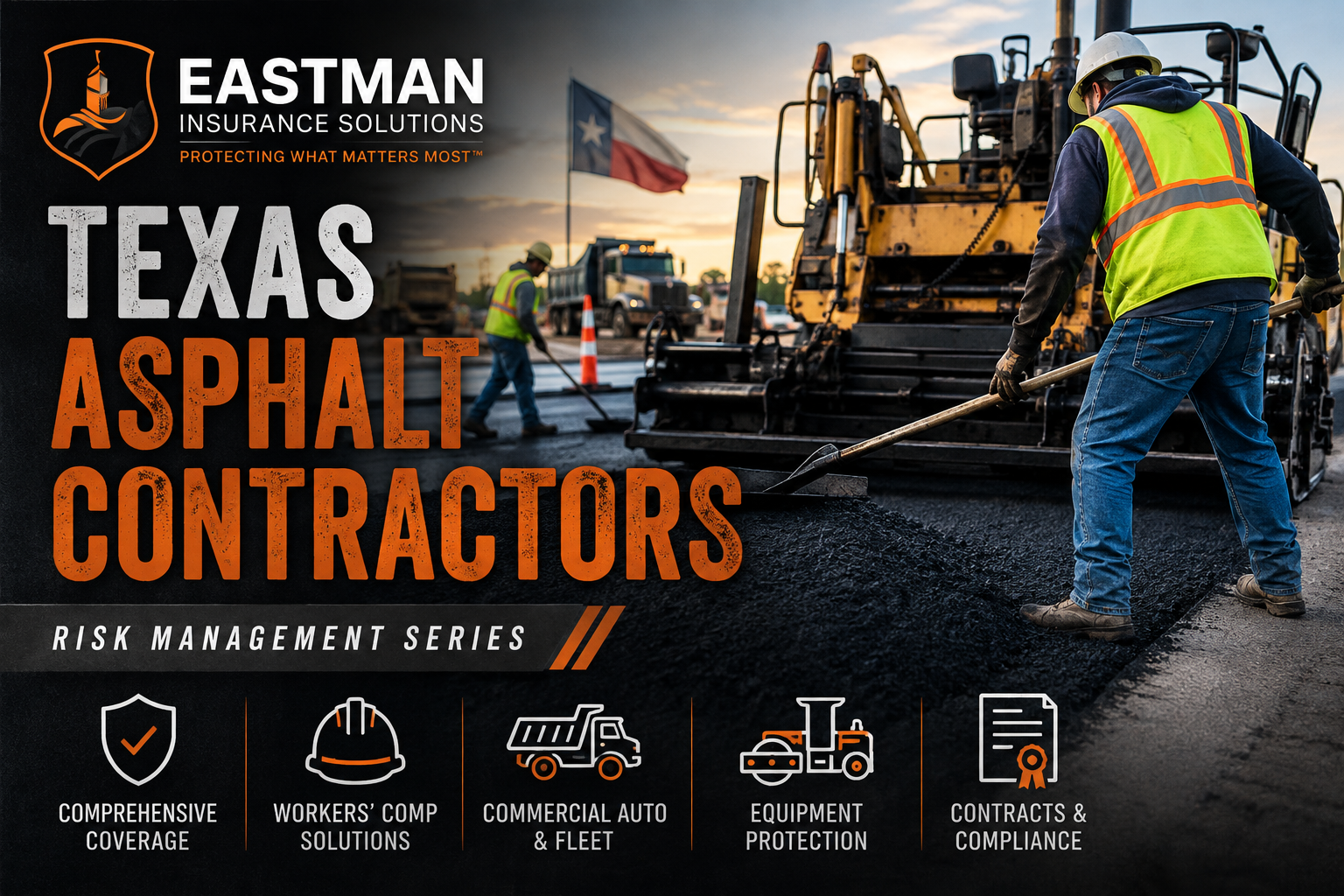
Asphalt and paving contractors operate in an environment where relatively routine work can create significant losses.
Employees work around moving equipment and traffic. Crews operate pavers, rollers, skid steers, loaders, dump trucks, and other heavy equipment. Commercial vehicles move between the yard, material suppliers, and jobsites. Equipment and materials may be spread across multiple projects.
As the company grows, those exposures multiply.
More crews mean more employees in the field.
More projects mean more equipment moving between jobsites.
More trucks mean greater highway exposure.
Larger contracts bring more demanding insurance requirements.
And when something goes wrong, the severity of the claim can be substantial.
At Eastman Insurance Solutions, we help Texas asphalt and paving contractors look beyond individual insurance policies and understand how their employees, vehicles, equipment, jobsites, contracts, and claims all contribute to the company’s overall cost of risk.
Here are some of the biggest risks established asphalt contractors should be evaluating.
1. Heavy Equipment Creates Significant Jobsite Exposure
Heavy equipment is central to an asphalt operation.
Pavers, rollers, loaders, skid steers, milling equipment, sweepers, and other machinery allow crews to work efficiently, but they also create significant exposure.
Potential losses can involve:
- Employees struck by equipment
- Equipment overturns
- Damage to surrounding property
- Collisions between vehicles and equipment
- Pedestrians or third parties entering the work area
- Equipment being loaded or unloaded
- Damage to underground utilities
- Equipment theft or vandalism
General Liability Insurance is an important part of protecting against certain third-party bodily injury and property damage claims.
But insurance should be only one part of the strategy.
Equipment operator training, jobsite controls, spotter procedures, high-visibility PPE, traffic management, and consistent safety expectations can all help reduce the likelihood of a serious loss.
The objective isn’t simply to insure the equipment exposure. It is to reduce the opportunity for the accident to occur.
2. Workers’ Compensation Can Become a Major Cost Driver
Asphalt work combines several employee injury exposures in the same operation.
Crews work around moving vehicles and heavy equipment. Employees perform physical labor, work outdoors in Texas heat, handle materials, enter and exit equipment, and may work alongside active vehicle traffic.
That creates opportunities for injuries involving:
- Strains and sprains
- Slips, trips, and falls
- Burns
- Heat-related illness
- Equipment accidents
- Struck-by injuries
- Vehicle accidents
- Material-handling injuries
For an established contractor, Workers’ Compensation Insurance shouldn’t be managed as an annual renewal transaction.
Pay attention to:
- Claim frequency
- Claim severity
- Open claim reserves
- Experience modification
- Employee classifications
- Return-to-work practices
- Supervisor involvement
- Recurring causes of employee injuries
One severe claim can be expensive.
A pattern of preventable claims can be even more damaging because it can affect future insurance costs and underwriting options.
The important question isn’t simply:
“What did our Workers’ Comp cost this year?”
It’s:
“What is causing our losses, and what can we do about it?”
For a deeper look at employee injury exposures specific to paving operations—including heavy equipment, struck-by hazards, traffic, heat, burns, field supervision, and claims management—read Workers’ Compensation for Asphalt Contractors: Managing High-Hazard Operations.
3. Commercial Auto Can Produce Some of the Most Severe Claims
Asphalt contractors often operate a mix of pickups, service vehicles, trailers, dump trucks, and other commercial vehicles.
Those vehicles may travel substantial distances between the company yard, suppliers, staging areas, and jobsites.
That makes Commercial Auto Insurance one of the most important parts of the insurance program.
It also makes driver management critical.
Established asphalt contractors should consider:
- Pre-employment driver screening
- Motor Vehicle Record reviews
- Driver eligibility standards
- Distracted-driving policies
- Accident-reporting procedures
- Vehicle-use policies
- Driver training
- Telematics where appropriate
- Corrective action following violations
- Trailer and equipment-towing practices
A serious commercial auto accident can produce bodily injury claims far exceeding the value of the vehicle involved.
As the fleet grows, driver management needs to become a formal business process rather than an informal expectation.
4. Work Zones Create Exposure to the Public
Many asphalt contractors don’t operate inside controlled construction sites.
Crews may work in parking lots, commercial properties, residential developments, municipal streets, or areas where customers, pedestrians, and vehicles remain nearby.
That introduces third-party exposure.
Potential claims can arise from:
- Vehicles entering active work areas
- Pedestrians crossing work zones
- Traffic-control failures
- Uneven surfaces
- Fresh pavement
- Construction debris
- Equipment movement
- Property damage
- Inadequate barricades or warnings
Jobsite planning becomes increasingly important when the public cannot be completely separated from the work.
The company should have consistent expectations around barricades, cones, signage, employee visibility, equipment movement, and traffic control.
A strong insurance program helps transfer risk.
A strong jobsite program helps prevent the loss.
5. Equipment Represents a Significant Capital Investment
An established asphalt contractor can have a substantial amount of money tied up in mobile equipment.
Unlike property sitting inside a building, that equipment moves.
It may be at the company yard today, on a commercial project tomorrow, and at another jobsite the following week.
Inland Marine Insurance can help protect certain mobile equipment and property while away from the company’s primary premises.
As equipment inventories grow, contractors should maintain accurate schedules addressing:
- Equipment descriptions
- Serial numbers
- Current values
- Ownership
- Leased or financed equipment
- Newly acquired equipment
- Rented equipment
- Typical storage locations
Values matter.
An equipment schedule that hasn’t been reviewed in several years may no longer reflect what it would actually cost to replace critical machinery.
6. Equipment Theft Can Disrupt More Than One Project
Heavy equipment theft creates two problems.
The first is the value of the stolen property.
The second is operational disruption.
If a critical piece of equipment disappears from a jobsite, the contractor may have crews scheduled and contractual obligations to meet without the machinery required to perform the work.
That makes theft prevention an operational issue as well as an insurance issue.
Controls can include:
- Secure equipment storage
- Key-management procedures
- GPS tracking
- Immobilization devices
- Jobsite lighting
- Equipment inventory procedures
- Employee accountability
- Prompt theft reporting
The larger the equipment fleet becomes, the more important it is to know where equipment is and who is responsible for it.
7. Underground Utility Damage Can Become Expensive Quickly
Asphalt and paving operations may involve excavation, grading, demolition, drainage work, site preparation, or other activities that create potential contact with underground utilities.
Damage to gas, electrical, telecommunications, water, sewer, or other underground infrastructure can create significant claims.
Depending on the circumstances, losses can involve:
- Physical repair costs
- Business interruption
- Emergency response
- Third-party property damage
- Bodily injury
- Loss of utility service
The appropriate controls depend on the work being performed, but utility-location procedures, project documentation, employee training, and clear responsibility for site preparation can be important.
Contractors should also understand how their General Liability policy addresses the operations they actually perform.
8. Contracts Can Transfer Significant Risk to the Contractor
Larger projects generally bring more sophisticated contracts.
General contractors, developers, municipalities, commercial property owners, and other customers may impose extensive insurance and indemnification requirements.
Those requirements can include:
- General Liability
- Commercial Auto
- Workers’ Compensation
- Umbrella or Excess Liability
- Additional insured status
- Primary and noncontributory wording
- Waivers of subrogation
- Completed operations
- Pollution Liability
- Specific coverage limits
The contract may also transfer liabilities that extend beyond the immediate paving work.
This is why insurance requirements should ideally be reviewed before the agreement is signed.
A certificate of insurance issued afterward doesn’t create coverage that isn’t provided by the underlying policies.
As project size increases, contractual risk transfer deserves more attention—not less.
9. Pollution Exposure Shouldn’t Be Ignored
Asphalt contractors may encounter fuels, oils, hydraulic fluids, chemicals, contaminated soil, runoff, and other environmental exposures.
Traditional General Liability policies may contain pollution exclusions or limitations.
Depending on the operation, Contractors Pollution Liability Insurance may be appropriate to address certain pollution-related bodily injury, property damage, cleanup, or environmental exposures.
Contractors should consider:
- Fuel storage
- Hydraulic-fluid releases
- Equipment leaks
- Contaminated soil
- Runoff
- Material handling
- Transportation exposures
- Environmental requirements contained in contracts
You don’t need to consider yourself an environmental contractor to experience an environmental claim.
10. Larger Projects Can Require Greater Liability Limits
Growth changes potential claim severity.
A contractor performing small private paving jobs has a different exposure profile from one performing larger commercial, municipal, or infrastructure work.
As operations grow, the company may have:
- More vehicles
- More employees
- More equipment
- Larger projects
- Higher-value contracts
- Greater public exposure
- More subcontractors
- More assets to protect
Commercial Umbrella and Excess Liability Insurance can provide additional limits above certain underlying liability policies.
Contract requirements may establish minimum limits.
But those requirements answer only one question:
How much insurance does the customer require?
An established contractor should also ask:
How much liability protection makes sense for the business we’ve built?
Your Claims History Tells a Story
For established asphalt contractors, one of the most valuable risk-management tools may already exist:
Your own loss history.
Look beyond the total dollars paid.
Ask:
- What types of claims keep occurring?
- Which crews or operations are involved?
- Are vehicle accidents increasing?
- Are employee injuries coming from similar activities?
- Are claims concentrated around certain equipment?
- Are losses occurring during particular phases of work?
- Are supervisors reporting incidents consistently?
- Are open claims being actively managed?
Loss runs aren’t simply documents an insurance company requests at renewal.
They provide a record of where the operation is producing financial loss.
Used correctly, they can help identify where risk-management efforts should be concentrated.
What Should a Growing Asphalt Contractor Review?
If your asphalt or paving company has added crews, vehicles, equipment, larger projects, or new operations, consider reviewing:
- Whether policies accurately describe current operations
- Workers’ Compensation loss performance
- Open claims and reserves
- Driver screening and fleet controls
- Heavy-equipment safety procedures
- Equipment schedules and current values
- Equipment theft controls
- Work-zone procedures
- Underground utility exposures
- Contractual insurance requirements
- Pollution exposures
- Umbrella and Excess Liability limits
The objective isn’t simply to purchase more insurance as the company grows.
The objective is to understand where the company is most likely to suffer a serious loss and decide what can be prevented, controlled, retained, or transferred.
Beyond the Coverage™ for Texas Asphalt Contractors
At Eastman Insurance Solutions, we believe established asphalt and paving contractors need more from an insurance relationship than an annual quoting exercise.
Our approach starts with understanding the operation behind the policies.
Identify Risk → Reduce Risk → Transfer Remaining Risk
That can involve insurance placement, Workers’ Compensation performance, fleet management, equipment protection, contractual risk transfer, claims advocacy, loss control, and ongoing review as the business changes.
Insurance is one component of the strategy.
The larger objective is protecting the business you’ve worked to build.
For additional resources specifically developed for asphalt and paving businesses, visit the Texas Asphalt & Paving Contractor Insurance and Risk Management Hub.
Frequently Asked Questions About Asphalt Contractor Insurance in Texas
What insurance should an established asphalt contractor carry?
There isn’t one standard insurance program appropriate for every asphalt or paving contractor.
Depending on the operation, coverage may include General Liability, Workers’ Compensation, Commercial Auto, Inland Marine, Commercial Property, Umbrella or Excess Liability, Contractors Pollution Liability, Cyber Liability, and other specialized insurance.
The appropriate structure depends on the company’s operations, employees, vehicles, equipment, project size, contracts, customers, and loss history.
Why is Commercial Auto such an important exposure for asphalt contractors?
Asphalt contractors can operate multiple pickups, service vehicles, trailers, dump trucks, and other commercial vehicles traveling between yards, suppliers, and jobsites.
The combination of vehicle size, road exposure, employee driving, and fleet growth can create significant potential claim severity.
How can an asphalt contractor control Workers’ Compensation costs?
Start by identifying what is causing employee injuries.
Claim frequency, severity, open reserves, experience modification, return-to-work practices, supervisor involvement, and recurring injury patterns can help identify where risk-management efforts should be focused.
How should an asphalt contractor insure heavy equipment?
Mobile equipment may require Inland Marine coverage rather than relying solely on traditional Commercial Property Insurance.
Contractors should maintain accurate equipment schedules, current values, and information about owned, financed, leased, and rented equipment so coverage can be structured around the actual operation.
When should an asphalt contractor review its insurance program?
Whenever the operation changes materially.
Adding crews, vehicles, heavy equipment, new services, larger contracts, or different types of projects can change the company’s risk profile before the next renewal.
Protect the Asphalt Contracting Business You’ve Built
Asphalt and paving companies invest heavily in people, equipment, vehicles, customer relationships, and the reputation required to win larger projects.
Growth creates opportunities.
It also increases the potential financial consequences when something goes wrong.
Eastman Insurance Solutions helps Texas asphalt and paving contractors connect commercial insurance, risk management, and claims strategy to the way their businesses actually operate.
If your company has grown but your insurance program hasn’t evolved with it, it may be time for a closer look.
Schedule a Risk Consultation →
Looking for more insurance tips?
- Why Workers’ Compensation Claims Are Different in Residential IDD Care
- Workers’ Compensation for Asphalt Contractors: Managing High-Hazard Operations
- Workers’ Compensation for Landscaping Companies: Controlling Crew Injuries
- Workers’ Compensation for Electrical Contractors: Managing Field Risk
- Why Workers’ Comp Claims Become Expensive for Plumbing Contractors